

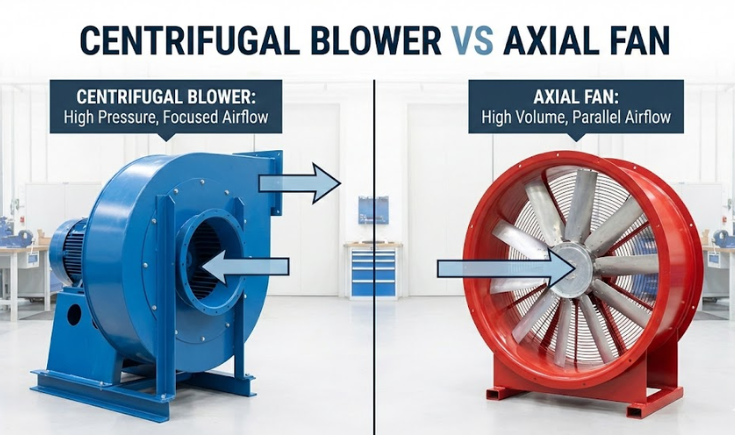
In industrial air-handling systems, selecting the right equipment is critical for efficiency, safety, and long-term performance. Two commonly compared options are Centrifugal Blowers and Axial Fans. While both are designed to move air, centrifugal blowers offer significant advantages over axial fans in many industrial applications, especially where pressure and reliability matter.
This blog explains the key advantages of centrifugal blowers over axial fans to help you choose the right solution.
Understanding the Basic Difference
The core difference lies in how they move air:
- A Centrifugal Blower: Draws air into the center of a rotating impeller and throws it outward using centrifugal force, creating higher air pressure.
- An Axial Fan: Moves air parallel to the shaft (like a ceiling fan) and is best suited for high airflow at low pressure.
This fundamental difference is what gives centrifugal blowers an edge in demanding industrial environments.
Key Advantages of Centrifugal Blowers Over Axial Fans
1. Superior Static Pressure Capability
Centrifugal blowers can generate much higher static pressure, allowing them to push air through ducts, filters, scrubbers, and cyclones. Axial fans often struggle as resistance increases, leading to significant performance loss.
2. Reliable Performance in Dusty and Harsh Conditions
Centrifugal blowers are better suited for dust-laden, fume-filled, or high-temperature air. Their enclosed design protects internal components, making them ideal for cement plants, foundries, and chemical industries where axial fans might fail due to buildup or erosion.
3. Consistent Airflow Under Variable Loads
As filters clog or duct resistance changes, centrifugal blowers maintain stable airflow. Axial fans tend to experience a sharp drop in efficiency and airflow under similar variable conditions.
4. Higher Efficiency in High-Pressure Applications
Although axial fans are efficient in open environments, centrifugal blowers consume less energy per unit of useful work in high-pressure systems. Using an axial fan in such applications often leads to higher power consumption and reduced equipment life.
5. Greater Design Flexibility
Centrifugal blowers come in various impeller designs—forward curved, backward curved, and radial blades—allowing customization for specific airflow, pressure, and material-handling requirements.
6. Lower Noise and Vibration Levels
With proper casing and impeller selection, centrifugal blowers generally produce lower operational noise and vibration compared to high-speed axial fans, improving workplace safety and comfort.
Centrifugal Blower vs Axial Fan: Quick Overview
| Feature | Centrifugal Blower | Axial Fan |
|---|---|---|
| Pressure Handling | High | Low |
| Duct Compatibility | Excellent | Limited |
| Dust Handling | Strong | Weak |
| Noise Control | Easier | Difficult |
| Industrial Reliability | High | Moderate |
Conclusion
While axial fans are suitable for simple ventilation and cooling, centrifugal blowers clearly outperform axial fans in industrial and high-pressure applications. Their ability to handle resistance, dust, and fluctuating conditions makes them the preferred choice for process-critical operations.
Choosing the right equipment ensures better efficiency, longer service life, and lower operating costs.
For expert advice on selecting the right blower for your facility, Contact Alfa Fans today.