

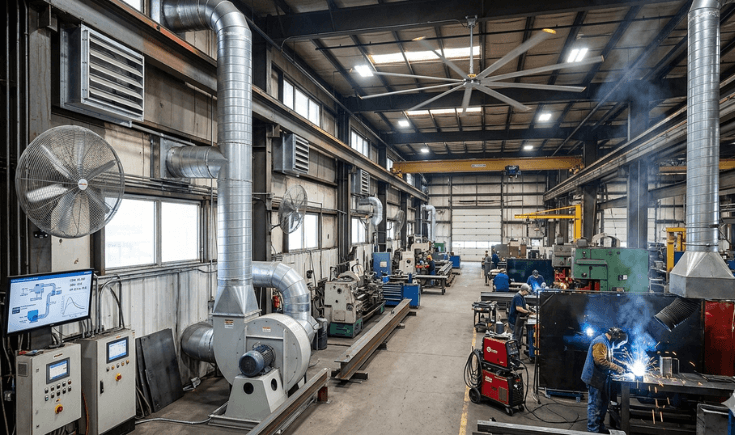
Fan capacity refers to the volume of air a fan can move within a specific time, usually measured in CFM (cubic feet per minute) or CMH (cubic meters per hour). It is a crucial factor in designing an effective industrial ventilation system and maintaining proper factory airflow management. Correct fan capacity helps control temperature, remove dust, fumes, and pollutants, and improve overall air quality in factories. This directly enhances worker productivity, ensures equipment longevity, and supports safe industrial operations, especially in high-heat manufacturing environments.
Key Factors Affecting Fan Capacity
Several important factors influence the calculation of industrial fanindustrial fan capacity. The size of the factory, including its length, width, and height, determines the total air volume that needs ventilation. The type of industry also plays a vital role, as processes like welding or heavy manufacturing generate more heat and pollutants compared to light industries. Additionally, the number of workers, machinery placement, and factory layout can impact airflow distribution. Considering these variables ensures accurate ventilation system design and optimal performance.
Types of Industrial Fans
Different types of industrial fans are used depending on the application and airflow requirements. Axial fans are ideal for moving large volumes of air in open spaces, making them suitable for general factory cooling.
Centrifugal fans
are better for high-pressure environments and duct-based systems. Anexhaust fan for industry
is essential for removing contaminated air, smoke, and heat, helping maintain a safe and clean working environment. Meanwhile,HVLS fans
(High Volume Low Speed) are widely used in large industrial facilities for efficient air circulation. Selecting the right fan type is essential for achieving effective industrial cooling solutions.Calculating Airflow Requirements
To calculate the required airflow for your factory, you first need to determine the total volume by multiplying the length, width, and height of the space. Once the volume is known, apply the appropriate air changes per hour (ACH) based on your industry type. Typically, light industries require 6–8 ACH, while heavy industries may need 10–15 ACH. The airflow requirement can then be calculated using
cfm calculation formula
: CFM = (Volume × ACH) ÷ 60. This calculation helps define the correct CFM calculation for factory ventilation and ensures sufficient air exchange.Importance of Static Pressure
Static pressure refers to the resistance airflow faces while moving through ducts, filters, and other obstructions in a ventilation system. Ignoring static pressure can lead to poor fan performance and inefficient airflow. It is essential to choose a fan that can handle both the required airflow (CFM) and the system’s static pressure. Proper consideration of static pressure ensures effective airflow distribution in industrial ventilation systems.
Using Fan Performance Curves
Fan performance curves are essential tools provided by manufacturers to help select the right fan. These curves show the relationship between airflow (CFM) and static pressure, allowing you to identify whether a fan can meet your specific requirements. By analyzing these curves, businesses can ensure energy efficiency, optimal airflow, and reduced operational costs in their
factory ventilation systems
.Common Mistakes to Avoid
Many industries make mistakes while calculating fan capacity, such as ignoring static pressure, using incorrect air exchange rates, or not accounting for future expansion. These errors can lead to inadequate ventilation, higher energy consumption, and reduced efficiency. Regular system evaluation and proper planning can help avoid these issues and ensure long-term performance of industrial airflow systems.
Conclusion
Calculating the correct fan capacity for factory ventilation is essential for maintaining a safe, productive, and energy-efficient work environment. By understanding airflow requirements, selecting the right fan type, and considering static pressure, businesses can significantly improve industrial air circulation and reduce operational costs. Implementing the right ventilation strategy not only enhances worker comfort but also supports sustainable industrial growth.