

Introduction
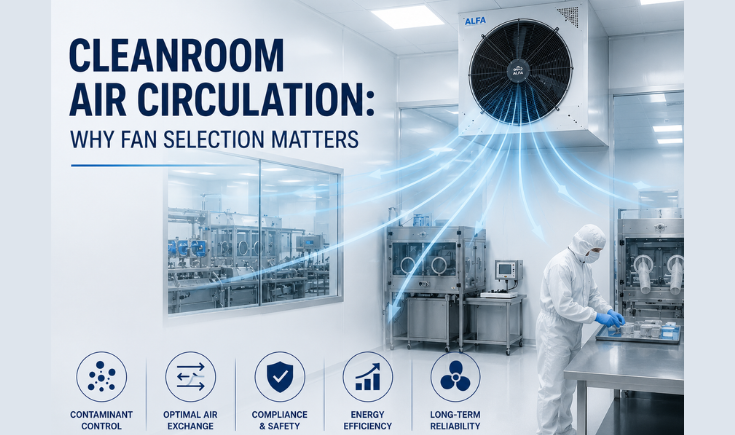
In high-precision industries such as pharmaceuticals, biotechnology, semiconductor manufacturing, and aerospace engineering, environmental control is paramount. Cleanrooms serve as the critical foundation for these production lines, keeping airborne particulates, microscopic organisms, and chemical vapors well within highly stringent limits. Achieving this level of atmospheric purity relies on a continuous, meticulously calculated air circulation strategy.
At the core of all effective cleanroom airflow solutions sits the industrial fan or centrifugal blower. Far from being simple components that shift volume, cleanroom fans must regulate directional paths, maintain specific pressures, and operate continuously without introducing impurities. Selecting an incorrect or un-optimized fan design can disrupt internal balance, compromise cleanroom ISO certifications, and lead to product contamination.
The Core Requirements of Cleanroom Airflow
Cleanroom environments isolate and eliminate contaminants using two distinct aerodynamic methods: unidirectional (laminar) flow and non-unidirectional (turbulent) flow. Laminar systems utilize parallel streams of air traveling at uniform velocities to drive particulates down into floor or wall returns. Turbulent systems introduce clean, filtered air through ceiling diffusers to continuously dilute atmospheric contaminants.
To make either approach function, the ventilation loop must contend with substantial system restriction. Air must pass through dense High-Efficiency Particulate Air (HEPA) or Ultra-Low Particulate Air (ULPA) filter banks. Overcoming this structural resistance requires high-performance industrial fans configured precisely for the system's static pressure curve.
Why Precision Fan Selection Matters
Industrial system designers must evaluate specific parameters to guarantee that air circulation equipment performs efficiently within a cleanroom configuration:
1. Overcoming High Filter Static Pressure
HEPA filters trap particles down to 0.3 microns with an efficiency rating of 99.97%, while ULPA filters deliver even greater capture capabilities. This filtration density causes high initial static pressure drops. As the filters capture particulates over months of continuous operation, their internal resistance increases further. The designated industrial fan must possess a stable pressure-volume characteristic curve to provide steady volumetric flow despite fluctuating system load.
2. Maintaining Accurate Air Change Rates (ACR)
Cleanrooms demand high air change rates to purge contaminants rapidly. Depending on the room's specific ISO classification, air change metrics can range from 15 to several hundred cycles per hour. If the fan selection falls short of the system pressure requirements, the air exchange rate will drop, allowing airborne particulates to settle on sensitive components or contaminate sterile compounds.
3. Minimizing Structural Vibration and Mechanical Noise
Controlled environments contain ultra-precise instrumentation, such as photolithography machinery or micro-balances, which are sensitive to minor structural oscillations. Standard industrial fans can transmit mechanical vibration through ductwork if not dynamically balanced to high tolerances. Vibration also stresses structural component seals, opening micro-gaps that bypass filter banks. Cleanroom fan selection demands precision-balanced impellers and heavy-duty, low-vibration bearing housings.
4. Eliminating Material Contamination and Outgassing
The construction materials of the fan assembly must not degrade or introduce pollutants into the airstream. Cleanroom fans require specialized chemical-resistant coatings, food-grade or non-outgassing lubricants, and robust shaft seal arrangements. This prevents motor grease aerosols or paint flakes from breaking away and entering the downstream cleanroom supply lines.
Cleanroom Airflow Metrics by Classification
Air circulation standards vary widely depending on the desired cleanroom purity level. The following table highlights typical operational values required across common ISO classes:
| ISO Classification | Equivalent Federal Class | Typical Air Change Rate (ACR) | Airflow Pattern Type |
|---|---|---|---|
| ISO 5 | Class 100 | 240 to 480 changes / hour | Unidirectional (Laminar) |
| ISO 6 | Class 1,000 | 150 to 240 changes / hour | Mixed / Unidirectional |
| ISO 7 | Class 10,000 | 60 to 90 changes / hour | Non-Unidirectional (Turbulent) |
| ISO 8 | Class 100,000 | 15 to 25 changes / hour | Non-Unidirectional (Turbulent) |
Optimizing Fan Technology for Controlled Environments
To deliver the necessary performance profiles, engineers generally specify two primary fan categories:
- High-Efficiency Centrifugal Blowers: Configured with backward-curved or airfoil impellers, these blowers develop the high static pressure required to force substantial air volumes through deep HEPA filter banks efficiently.
- Direct-Drive Plug Fans: By removing belt drives, plug fans eliminate the risk of rubber particulate debris shedding into the HVAC housing. They integrate seamlessly into Fan Filter Units (FFUs) and air handling systems, offering compact footprints and precise variable-speed electronic controls.
Conclusion
Implementing successful cleanroom airflow solutions requires balancing static pressure, air change metrics, material composition, and mechanical balancing. Selecting a fan without evaluating these parameters risks environmental contamination, increased energy consumption, and premature equipment wear.
Ensuring dependable, contamination-free air management starts with robust engineering design. Alfa Fans manufactures high-performance industrial centrifugal blowers and customized ventilation systems engineered to meet the strict demands of controlled industrial environments. By pairing precision dynamic balancing with premium-grade component housings, Alfa Fans keeps your critical manufacturing systems clean, code-compliant, and running smoothly.