
- Gala No. 19, 2nd Floor,
Bail Bazar, Mumbai, India - +91 88 5002 0455
info@alfafans.in

Established in 1981, Alfa Fans is a premier
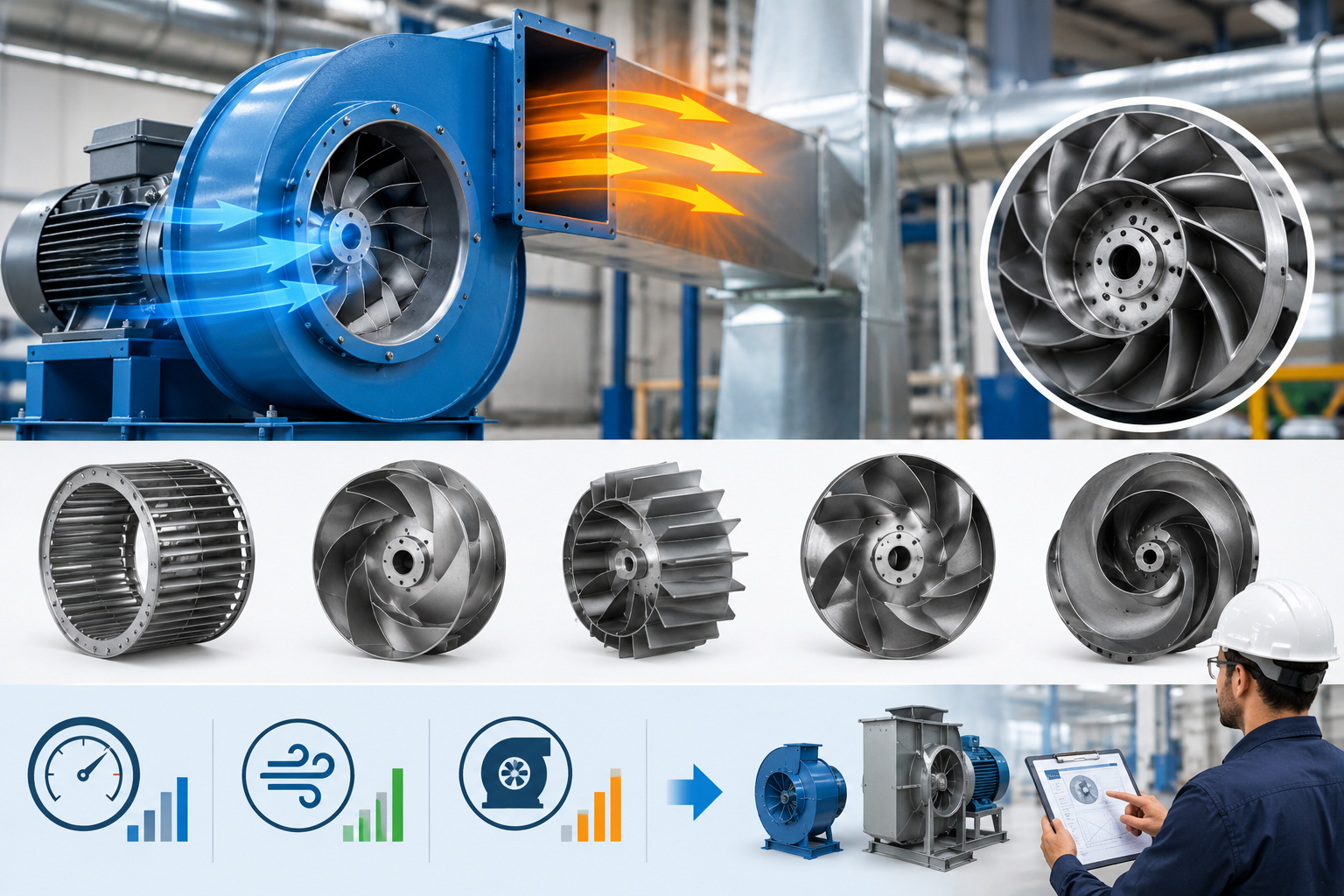
Selecting the right industrial blower requires a deep understanding of aerodynamics and fluid dynamics. At the core of every centrifugal blower is the impeller—its blade design, inclination, and geometry directly determine overall airflow (CFM), static pressure capability, motor power consumption, and mechanical efficiency.
Forward-curved blades curve in the direction of the impeller's rotation. These impellers feature a large number of smaller blades that deliver large volumes of air (CFM) at relatively low operating speeds and low static pressure.
Backward-Inclined and Backward-Curved Impellers
Backward-inclined blades curve away from the direction of rotation. Known for their high mechanical efficiency (up to 85%),
Radial blade impellers extend straight outward from the wheel hub. Although less aerodynamic than curved designs,
Know the difference between Fans and Air Blowers | Centrifugal Blowers and Industrial Exhaust Selection | Heavy Duty Exhaust Fans for High-Pressure Industrial Applications |