
- Dubai,
United Arab Emirates - +91 88 5002 0455
info@alfafans.in

Maintaining proper indoor air quality and temperature in large manufacturing plants is
essential for worker safety, productivity, and machinery health. However, heavy industrial
ventilation systems and constant air conditioning can lead to soaring utility bills.
Fortunately, optimizing your plant's airflow doesn’t require overhauling your entire
electrical grid. Here are effective, energy-efficient strategies to improve factory
ventilation while keeping operational costs under control.
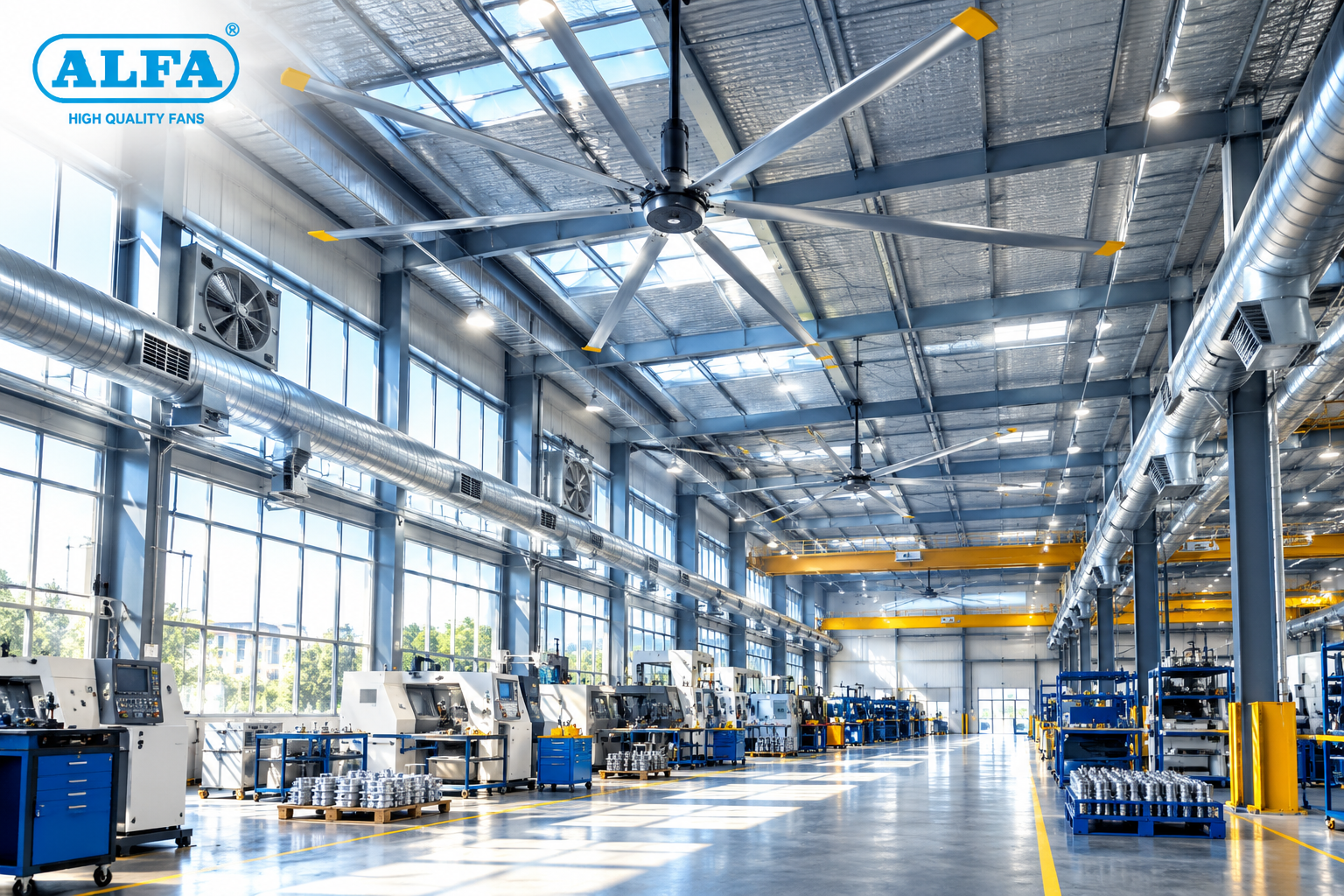
1. Leverage High-Volume Low-Speed (HVLS) Air Circulators
Traditional high-speed fans consume massive amounts of electrical power while only providing
narrow streams of air, leaving large portions of the facility stagnant.
The Energy-Saving Solution: Large-diameter HVLS fans and Air
Circulators move massive volumes of air at low rotational speeds using highly
efficient gearless or geared motors. A single HVLS fan can cover thousands of square feet,
replacing dozens of smaller standard fans and drastically reducing overall energy
consumption while maintaining a comfortable cooling breeze across the floor.
2. Optimize Natural Ventilation with Strategic Exhaust Placement
Relying entirely on mechanical supply air systems drives up energy costs. Capitalizing on
natural pressure differentials and building physics can do much of the heavy lifting.
The Energy-Saving Solution: Install heavy-duty exhaust
fans and roof ventilators near the ceiling where warm air naturally accumulates. By
drawing out hot air passively or through low-wattage extraction, you create a negative
pressure draft that pulls fresh, cooler ambient air in through lower-level doors and windows
without needing complex powered intake systems.
3. Use Targeted Man Coolers Instead of Whole-Space Cooling
Cooling an entire massive manufacturing facility to comfort standards is financially
impractical and wastes vast amounts of energy on empty zones or storage spaces.
The Energy-Saving Solution: Deploy heavy-duty man coolers
directly at specific operator stations and active workstations. Instead of conditioning the
entire volume of a massive plant, directional spot cooling gives workers immediate thermal
relief right where they need it, using a fraction of the energy required for complete space
cooling.
4. Integrate Smart Controls and Variable Frequency Drives (VFDs)
Running ventilation equipment at 100% capacity 24/7—regardless of shift changes, weather
fluctuations, or seasonal shifts—is a primary source of wasted energy.
The Energy-Saving Solution: Equip your tube axial fans,
centrifugal blowers, and exhaust systems with Variable
Frequency Drives (VFDs) and smart thermal sensors. Automated controls adjust fan speeds
dynamically based on real-time temperature, humidity, and occupancy levels, ensuring energy
is only expended when and where airflow demand actually requires it.
Conclusion
Improving factory ventilation is not just about moving more air—it is about moving air
smarter. By transitioning to high-efficiency industrial fans, optimizing strategic exhaust
placement, and utilizing localized spot cooling, manufacturing plants can drastically
improve working conditions while achieving significant long-term energy savings.
Big Industrial Fan Manufacturer In India-Alfa Fans | A Simple Guide to keep your Industrial Fans clean | Materials used in Industrial Fans