

Introduction
Large warehouses and industrial facilities often struggle with maintaining indoor comfort while controlling rising electricity costs. Poor airflow, uneven temperature distribution, and excessive HVAC usage can significantly increase operational expenses in industrial spaces. As businesses focus more on energy-efficient
warehouse cooling systems
, HVLS fans have become one of the most effective industrial ventilation solutions for reducing HVAC costs in large warehouses.
HVLS fans
or High Volume Low Speed fans are specially designed industrial ceiling fans that circulate massive volumes of air at low rotational speeds. Unlike conventional industrial fans, HVLS warehouse fans create consistent airflow across large floor areas, improving indoor comfort and reducing dependency on air conditioning systems. Industries such as logistics, manufacturing, automotive, warehousing, and retail distribution increasingly rely on industrial HVLS fan systems to improve energy efficiency and worker productivity.Understanding How HVLS Fans Work
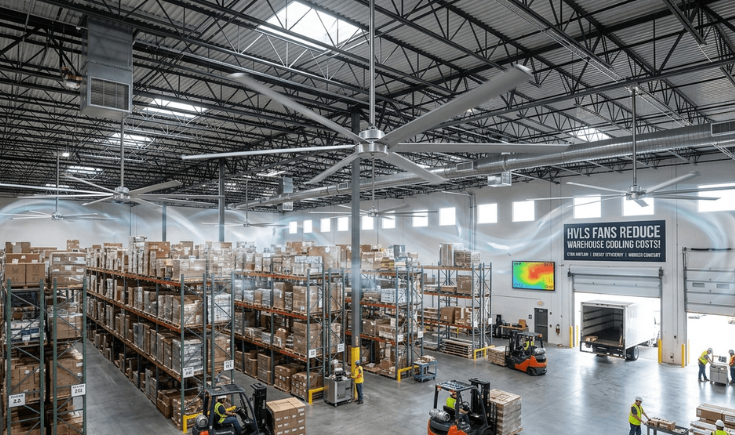
HVLS fans are engineered with large blades that move air slowly but efficiently throughout industrial facilities. These fans are generally installed on high warehouse ceilings where they can distribute airflow evenly across wide operational areas. The primary purpose of HVLS fans is to eliminate stagnant air and maintain balanced temperature conditions.
In large warehouses, hot air naturally rises and becomes trapped near the ceiling, while cooler air stays near the floor. This uneven air distribution forces HVAC systems to work harder to maintain indoor temperatures. HVLS industrial fans continuously mix warm and cool air layers, creating balanced airflow throughout the warehouse and reducing temperature stratification.
During summer, HVLS fans create a natural cooling effect by increasing air movement around workers and equipment. In winter, they help redistribute trapped warm air downward, reducing heating requirements and improving overall HVAC efficiency.
Reducing HVAC Energy Consumption
One of the biggest benefits of HVLS warehouse fans is their ability to reduce
HVAC energy usage
. Traditional cooling systems often consume excessive electricity because of poor airflow management and uneven cooling distribution in industrial buildings.By improving warehouse airflow circulation, HVLS fans allow businesses to increase thermostat settings while still maintaining worker comfort. Even slight thermostat adjustments can generate noticeable energy savings over time. Warehouse operators often experience lower electricity bills after implementing energy-efficient HVLS fan systems.
HVLS fans also reduce pressure on HVAC units by helping conditioned air reach all areas of the facility more effectively. This reduces continuous cooling cycles, minimizes wear on HVAC equipment, lowers maintenance costs, and extends the lifespan of industrial cooling systems.
Improving Worker Comfort and Productivity
Employee comfort plays a critical role in warehouse productivity and operational efficiency. Large industrial spaces often become uncomfortable because of heat accumulation, humidity, and insufficient ventilation. Workers exposed to excessive heat may experience fatigue, dehydration, and reduced concentration.
HVLS fans create gentle and consistent airflow that helps regulate body temperature naturally. Improved air movement makes employees feel cooler without over-relying on air conditioning systems. Better ventilation also reduces humidity and creates fresher indoor environments, improving overall workplace conditions.
Comfortable working environments contribute to higher productivity, improved employee satisfaction, and reduced absenteeism. Many industries now consider
industrial airflow management systems
an essential investment for workforce efficiency and operational safety.Supporting Sustainable Warehouse Operations
Sustainability has become a major focus for modern warehouses and industrial facilities. Businesses are increasingly investing in eco-friendly industrial ventilation solutions that reduce energy consumption and support environmental goals.
HVLS fans consume relatively low electricity while delivering powerful airflow coverage across large warehouse spaces. Their ability to reduce HVAC dependency helps companies lower overall energy usage and reduce carbon emissions.
Many organizations pursuing green building certifications and sustainable industrial operations incorporate HVLS warehouse cooling systems into their energy management strategies. These industrial fans help companies achieve long-term operational savings while supporting environmentally responsible business practices.
Why HVLS Fans Are Ideal for Large Warehouses
Large warehouses present unique ventilation challenges because of high ceilings, open layouts, and continuous operational activities. Traditional pedestal fans and smaller industrial fans often provide only localized airflow, making them ineffective for large-scale industrial environments.
HVLS ceiling fans are specifically designed to move air efficiently across massive warehouse floors. Their wide coverage area makes them ideal for logistics hubs, manufacturing plants, distribution centers, automotive facilities, airports, gymnasiums, and storage warehouses.
Another important advantage of HVLS industrial fans is quiet operation. Unlike multiple smaller fans or heavy HVAC systems, HVLS fans operate with minimal noise while maintaining consistent airflow. Warehouse operators also benefit from low maintenance requirements and long operational lifespan.
Future of HVLS Fans in Industrial Ventilation
The future of industrial ventilation is increasingly focused on smart energy management and automated airflow systems. Modern HVLS fan technologies are now integrated with smart sensors, IoT-based monitoring systems, and automated climate controls.
Warehouse managers can monitor airflow performance, temperature distribution, and energy consumption through intelligent control systems. Smart HVLS fans automatically adjust fan speed based on environmental conditions, helping maximize efficiency and reduce operational costs.
As industrial facilities continue expanding and energy costs rise globally, the demand for advanced warehouse ventilation systems and energy-efficient cooling technologies is expected to grow significantly.
Conclusion
HVLS fans have transformed warehouse ventilation by improving airflow, reducing HVAC workload, and lowering industrial energy costs. These advanced industrial fans provide long-term benefits by enhancing indoor comfort, improving employee productivity, and supporting sustainable warehouse operations.
In today’s competitive industrial environment, businesses are actively searching for warehouse cooling solutions that improve efficiency without increasing operational expenses. HVLS fans offer an effective and environmentally responsible solution for modern industrial infrastructure.
From reducing electricity bills and improving warehouse airflow management to creating better working conditions, HVLS fan systems are becoming an essential investment for large industrial facilities seeking energy-efficient ventilation solutions.