• Gala No. 19, 2nd Floor,
    Bail Bazar, Mumbai, India
  • +91 88 5002 0455
    info@alfafans.in
Request A Quote
Industrial Fan Selection Guide
Choosing the Right Industrial Fan
25
Nov

How to Choose the Right Industrial Fan for Your Facility: A Technical Buyer’s Guide

  • Nov, 2023
  • Alfa Fans
  • BLOG

Choosing the right industrial fan is essential for controlling airflow, improving indoor air quality, and maintaining safe working conditions. With multiple fan types and performance requirements, understanding key selection criteria helps reduce energy costs and boost operational efficiency. This guide outlines the most important factors to consider.

1. Define the Fan’s Purpose

Start by identifying the primary application:

  • General ventilation
  • Heat or humidity control
  • Fume and dust extraction
  • Equipment or process cooling

  • Each use case requires specific airflow and pressure capabilities.


    2. Calculate Airflow Needs (CFM)

    Airflow is measured in CFM (Cubic Feet per Minute). Use this simplified formula:


    CFM = frac(Room Volume * times Desired Air Changes per Hour){60}


    Higher-intensity environments—like welding areas or chemical rooms—require significantly higher ACH (Air Changes per Hour) values.


    3. Understand Static Pressure (SP)

    Static pressure represents airflow resistance within ducts, filters, or hoods. Sizing for the correct SP is critical to prevent airflow loss and energy waste.


    4. Choose the Right Fan Type


    Axial Fans


    Characterized by high airflow at low pressure.

  • Ideal for warehouses, comfort cooling, and general ventilation.

  • Centrifugal Fans


    Known for generating high pressure at

    • lower noise levels compared to axial types.
    • Best for filtration systems, dust collection, and fume removal requiring ducted airflow.

    HVLS Fans


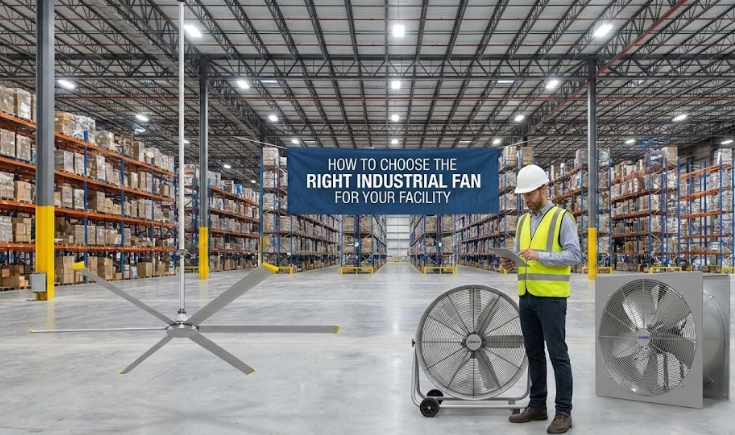
    • High-Volume, Low-Speed fans feature a large diameter and operate at low rotational speeds. They move massive amounts of air over a wide area efficiently.

      • Perfect for large facilities, like distribution centers and manufacturing plants, needing energy-efficient air movement and destratification.


      5. Consider Environmental Conditions

      Fan materials and motor ratings must match your environment to ensure longevity and safety:

      • High humidity: Choose coated or stainless steel fans.
      • Corrosive air: Select fans with chemical-resistant housing.
      • Explosive atmospheres: Mandates the use of UL or ATEX certified explosion-proof motors.

      6. Evaluate Motor Efficiency

      For long-term cost savings, prioritize efficiency:

      • Choose EC motors or high-efficiency TEFC (Totally Enclosed Fan Cooled) motors.
      • Add VFD (Variable Frequency Drive) controls for adjustable speed and improved energy optimization.

      7. Noise, Maintenance & Compliance

      Don't overlook operational factors:

      • Check noise ratings (dB) to maintain worker comfort and adhere to local regulations.
      • Look for accessible service points and durable bearings to simplify maintenance.
      • Ensure compliance with certification from bodies like AMCA, UL, NFPA, or OSHA depending on your facility’s needs.

      Final Thoughts

      The right industrial fan balances airflow performance, static pressure capability, energy efficiency, and environmental durability. By thoroughly evaluating your application, accurately calculating airflow needs, and selecting a properly rated fan type, you can significantly improve safety, boost productivity, and reduce overall operating costs.

      Shares

      Leave a Reply