

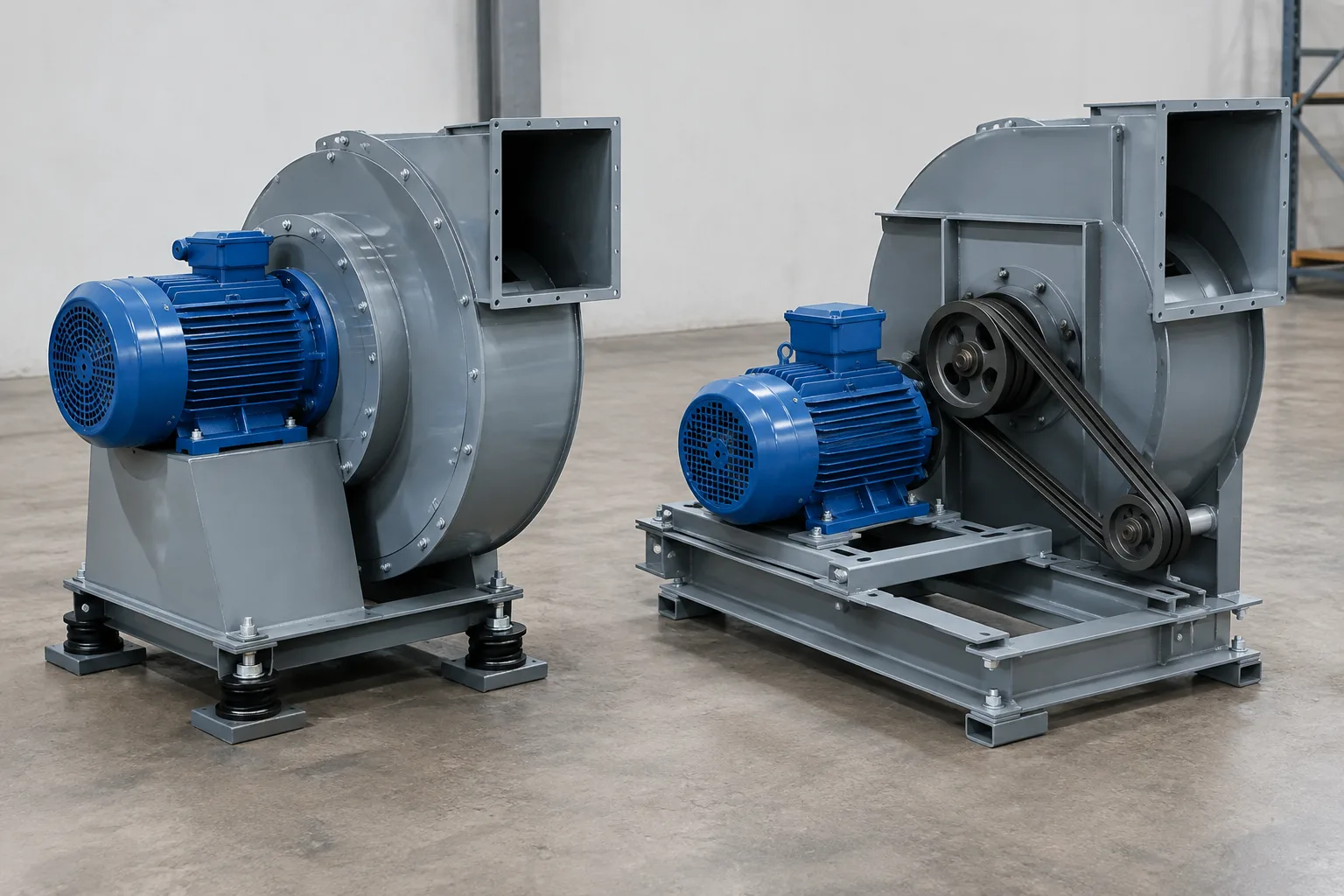
When comparing direct drive vs belt drive industrial fans, choose direct drive when the fan runs at one fixed duty and you want minimum maintenance, and choose belt drive when you need to set or change fan speed, handle hot or dirty air away from the motor, or drive a large impeller against high static pressure. Direct drive gives fewer wearing parts and no belt losses. Belt drive gives flexibility, at the cost of regular belt and pulley upkeep.
The right industrial fan drive arrangement depends on your airflow and static-pressure requirements, air temperature, the environment around the fan and who will maintain it. The sections below explain each factor in practical terms so a plant manager, purchase team or contractor can make the call with confidence.
Direct drive vs belt drive industrial fans: the short answer
A direct drive fan has its impeller or blades mounted on the motor shaft, or connected through a coupling, so the fan turns at motor speed. A belt drive fan has the motor mounted separately, with pulleys and V-belts transferring power to a fan shaft running in its own bearings.
- Direct drive suits: fixed-duty air circulation, spot cooling, general ventilation, compact installations and sites with limited maintenance staff.
- Belt drive suits: process duties where the exact operating point matters, high-temperature or dusty airstreams, large centrifugal impellers and applications where speed may need adjusting after commissioning.
How each drive arrangement works
Direct drive
In a direct drive fan, the motor and impeller rotate together. With no belts or pulleys, there are fewer components to wear, align or replace. The trade-off is that fan speed is tied to motor speed. A standard induction motor runs close to its rated speed, so if the installed fan delivers too much or too little air, the usual options are a different motor, a different impeller or a variable frequency drive (VFD).
Belt drive
In a belt drive fan, the motor sits on an adjustable base and drives the fan shaft through pulleys. Changing the pulley ratio changes fan speed, which lets the fan be matched closely to the system. The fan shaft runs in separate bearings, so the motor can be kept outside the airstream.
The Air Movement and Control Association (AMCA) publishes standard drive arrangement designations for centrifugal fans that buyers and consultants use when specifying. For example, AMCA Arrangement 4 describes an impeller overhung directly on the motor shaft (a direct drive), while Arrangement 9 describes a belt-driven fan with the motor mounted on the outside of the bearing base. Quoting the arrangement in your enquiry removes ambiguity between the specifier, the contractor and the manufacturer.
Comparing the two on the factors that matter
- Energy efficiency: direct drive has no transmission losses. Belts lose some power through flexing and slip, and this loss grows as belts wear or lose tension.
- Speed flexibility: belt drive allows speed changes with a pulley swap. Direct drive needs a VFD or multi-speed motor to achieve the same.
- Maintenance: direct drive mainly needs motor bearing checks. Belt drive adds belt tension checks, pulley alignment, belt replacement and fan shaft bearing lubrication.
- Air temperature and contamination: belt drive keeps the motor out of hot, dusty or corrosive air. Many direct drive designs place the motor in the airstream, so the motor rating limits the air temperature the fan can handle.
- Space: direct drive is usually more compact. Belt drive needs room for the motor base, pulleys and a belt guard.
- Cleanliness: belts shed fine dust as they wear, which matters in food-processing and pharmaceutical areas.
- Initial cost: for small and medium fans, direct drive is often simpler to build. For large fans, the comparison depends on motor speed and size, so it should be checked case by case.
Speed control and the fan laws
Fan speed has a large effect on running cost. The fan affinity laws, a standard part of fan engineering, state that air delivery varies directly with speed, static pressure varies with the square of speed and absorbed power varies with the cube of speed. In practical terms, a small reduction in speed gives a much larger reduction in power.
This is why belt drive has traditionally been popular: the fan can be set to the speed the system actually needs instead of running faster and being throttled with dampers. Today, a VFD on a direct drive fan can deliver the same benefit with infinite adjustment and no belt losses, provided the motor is suitable for inverter duty. If your plant already uses VFDs, a direct drive fan with a drive is often the most energy-efficient air circulation option. Our article on how centrifugal blowers reduce energy costs covers more on matching blower duty to actual demand.
When selecting or replacing motors, also check the efficiency class. Motor efficiency classes such as IE2 and IE3 are defined in IEC 60034-30-1, and in India in IS 12615. A higher efficiency motor helps whichever drive arrangement you choose.
When a direct drive fan is the better choice
Direct drive is the practical choice for most general cooling and ventilation duties, where the fan runs at one speed for long hours:
- Pedestal, wall-mount and tubular man coolers for spot cooling at workstations
- Air circulators moving high-volume airflow across shop floors and warehouses
- Tube axial and axial flow fans for general supply and extraction
- Heavy duty exhaust fans on walls and roofs handling ambient-temperature air
- Areas where cleanliness matters and belt dust is unwelcome, such as many food-processing and pharmaceutical zones
For these duties, aerodynamically designed blades on a direct drive motor give reliable air delivery with minimal routine attention, which is valuable in plants with small maintenance teams.
When belt drive makes more sense
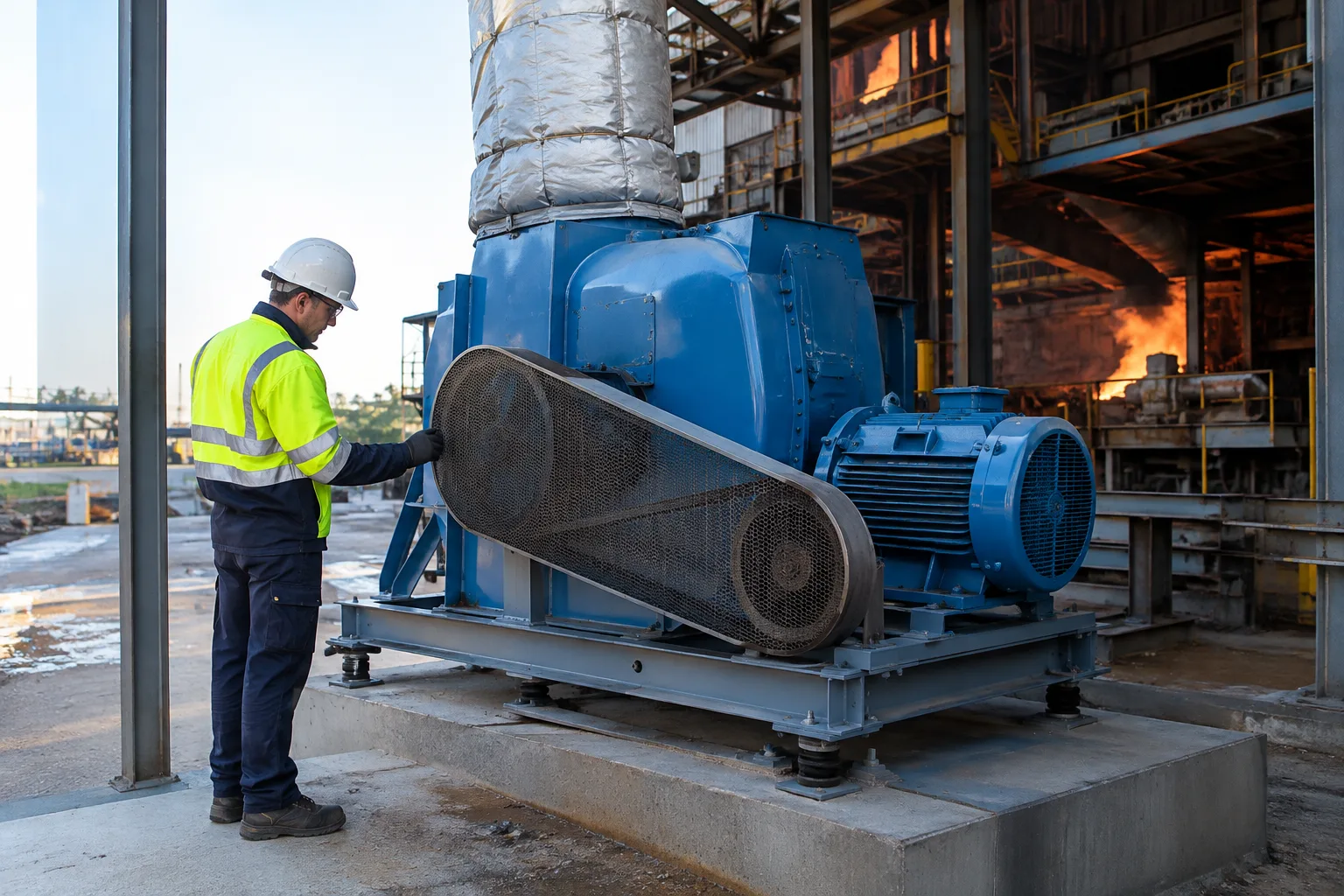
Belt drive earns its extra upkeep where the duty is demanding or uncertain. A belt driven centrifugal blower is common for:
- Hot gas handling in foundries, steel plants, furnaces and dryers, where the motor must stay clear of the airstream
- Dust-laden or fume extraction through ducting, filters and scrubbers, where system resistance may not be fully known until commissioning
- High static pressure duties needing larger impellers at speeds that do not match standard motor speeds
- Systems likely to change, such as a plant adding extraction points later, where a pulley change can raise air delivery
If you are working on one of these duties, see our range of centrifugal blowers manufactured in Mumbai, or read about the industrial processes that use centrifugal fans and blowers to see where each design fits. An overview of the types of industrial fan blowers is also useful when comparing axial and centrifugal options.
Industrial fan maintenance cost over the fan's life
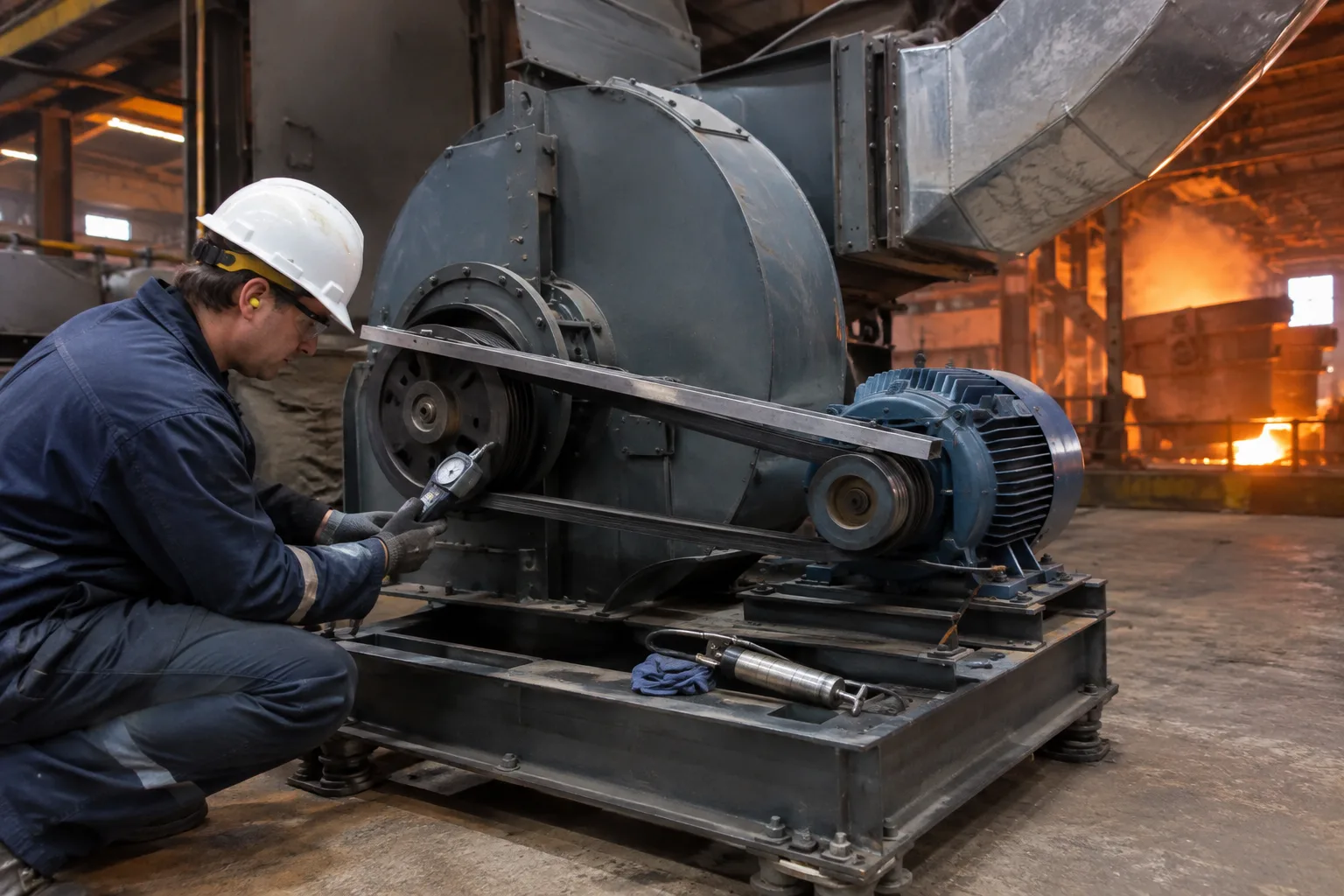
Purchase price is only part of the decision. Industrial fan maintenance cost differs clearly between the two arrangements:
- Direct drive: periodic checks of motor bearings, vibration, impeller cleanliness and electrical connections.
- Belt drive: all of the above, plus belt tension and wear checks, pulley alignment, belt replacement and lubrication of the fan shaft bearings.
A belt that is too loose slips, runs hot and reduces air delivery. A belt that is too tight overloads the bearings. Misaligned pulleys cause vibration and early belt failure. None of these are reasons to avoid belt drive where it is needed, but your maintenance team should have a clear schedule. Where a duty can be handled by a direct drive fan, the lower upkeep supports long-term operational performance.
What to share when requesting a quotation
As industrial fans and blowers manufacturers in India since 1981, Alfa Fans has an engineer-led Research and Development team that recommends the drive arrangement as part of application-specific fan selection. To get an accurate recommendation, share:
- Required air delivery and static pressure, or the space dimensions and purpose if these are not yet known
- Air temperature, and whether the air carries dust, moisture, fumes or corrosive vapours
- Whether a flameproof motor is needed for the area classification
- Available power supply and whether a VFD is already used on site
- Mounting position, space available and any ducting details
- Your maintenance capability and expected running hours
Where standard models do not fit, we build custom-made fans designed around operating conditions, in either direct or belt drive. To discuss your application requirements or request a quotation, contact the Alfa Fans technical team.
Frequently asked questions
Is a direct drive industrial fan more energy efficient than a belt drive fan?
At the same operating point, direct drive avoids the power lost through belt flexing and slip, so it is usually more efficient. Belt losses also increase as belts wear or lose tension. However, a belt drive fan set to the correct speed can use less energy than a direct drive fan running faster than the system needs, which is why matching speed to duty matters as much as the drive type.
Can I control the speed of a direct drive industrial fan?
Yes. A variable frequency drive (VFD) can adjust the speed of a direct drive fan, provided the motor is suitable for inverter duty. Multi-speed motors are another option for simpler step control. Check with the manufacturer before fitting a VFD to an existing fan.
Why are belt drives used for high-temperature fans?
In a belt drive fan, the motor sits outside the airstream, so it is not exposed to hot gases from furnaces, dryers or foundry processes. Many direct drive designs place the motor in the air path, which limits the temperature the fan can handle. For hot gas duties, belt drive or a suitably designed direct drive arrangement with the motor kept outside is normally specified.
How often do belts on an industrial fan need checking?
Belt tension and condition should be checked as part of routine maintenance, and more often in the first weeks after installing new belts because they stretch as they bed in. The exact interval depends on running hours, load and environment. Your fan manufacturer's maintenance guidance should set the schedule.
Does Alfa Fans make both direct drive and belt drive fans?
Alfa Fans manufactures air circulators, man coolers, exhaust fans, tube axial fans and centrifugal blowers, and builds custom fans to customer specifications. The drive arrangement is recommended based on your airflow, static pressure, air temperature and maintenance needs. Share your application details with the technical team to get a recommendation and quotation.