

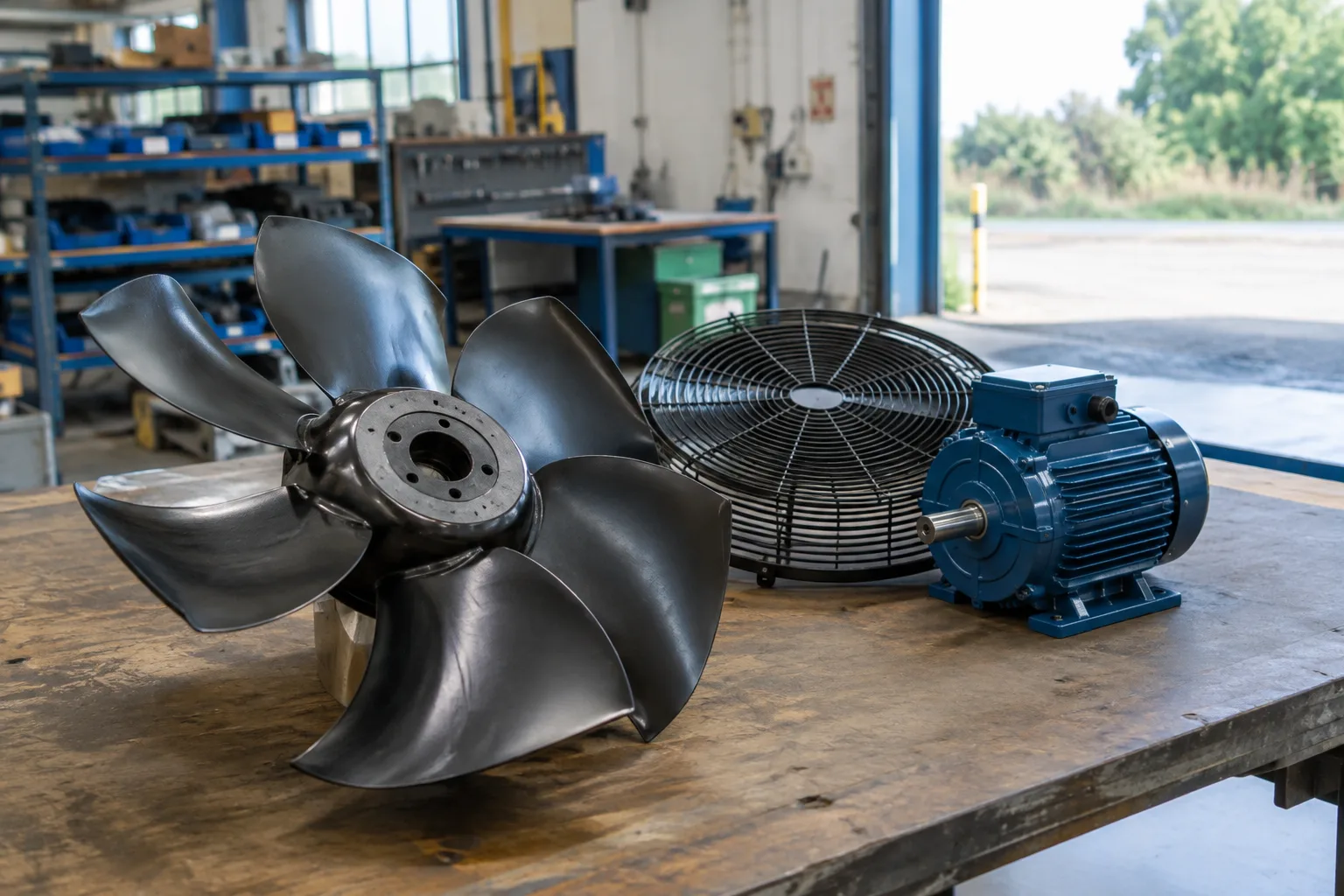
An industrial fan noise level is set mainly by blade tip speed, blade design, turbulence at the inlet and outlet, and mechanical sources such as bearings, motors and imbalance. It is reported in dB(A), a sound level weighted to match human hearing, and the figure only means something when the measuring distance and test method are stated. To specify a quieter fan, give the supplier your exact duty point, size the fan to run slower, and choose aerodynamically designed blades matched to your system's static pressure.
The sections below explain where fan noise comes from, how dB(A) figures are produced and compared, and what to put in your enquiry so the fan you receive is quiet on your shop floor, not just on a brochure.
What Determines an Industrial Fan Noise Level
Fan noise has two broad sources: the air itself and the machine moving it. In a well-built fan running at its correct duty point, aerodynamic noise dominates. In a worn or badly installed fan, mechanical noise often takes over.
Aerodynamic noise: tip speed, blade pass and turbulence
Every time a blade passes a fixed point (a guard strut, a motor support or the casing), it creates a pressure pulse. This gives a tonal hum at the blade pass frequency, calculated as the number of blades multiplied by the speed in rpm, divided by 60. A four-blade impeller at 1,440 rpm produces a tone at 96 Hz, which is why some axial fans have a steady low drone rather than a broad rush of air.
The other part of aerodynamic noise is broadband turbulence: air separating from the blade surface, vortices shedding at the blade tips and air striking obstacles. Tip speed is the biggest single driver. The faster the blade tip travels, the louder the fan, and the relationship is steep, as the fan laws below show.
System effects: where the fan is installed
A fan that is quiet on a test rig can be noisy on site. Common causes include a bend or damper directly at the inlet, an undersized duct that forces the fan to work against higher static pressure than planned, and a fan selected so it operates away from its peak efficiency. When an axial fan is pushed into the stall region of its curve, airflow breaks away from the blades and noise rises sharply. Understanding how a fan's performance is rated helps here, and our guide on how industrial fans are measured explains air delivery, static pressure and the curves that link them.
Mechanical noise: bearings, balance and loose parts
Mechanical noise includes bearing rumble, motor hum, belt slap on belt-drive units, rattling guards and the vibration caused by an out-of-balance impeller. These sounds usually grow over time, so a rising noise level is often an early warning rather than a design flaw. If an existing fan has become louder, read our article on how to identify problems causing industrial fan failure before deciding to replace it.
How dB(A) Is Measured and Compared
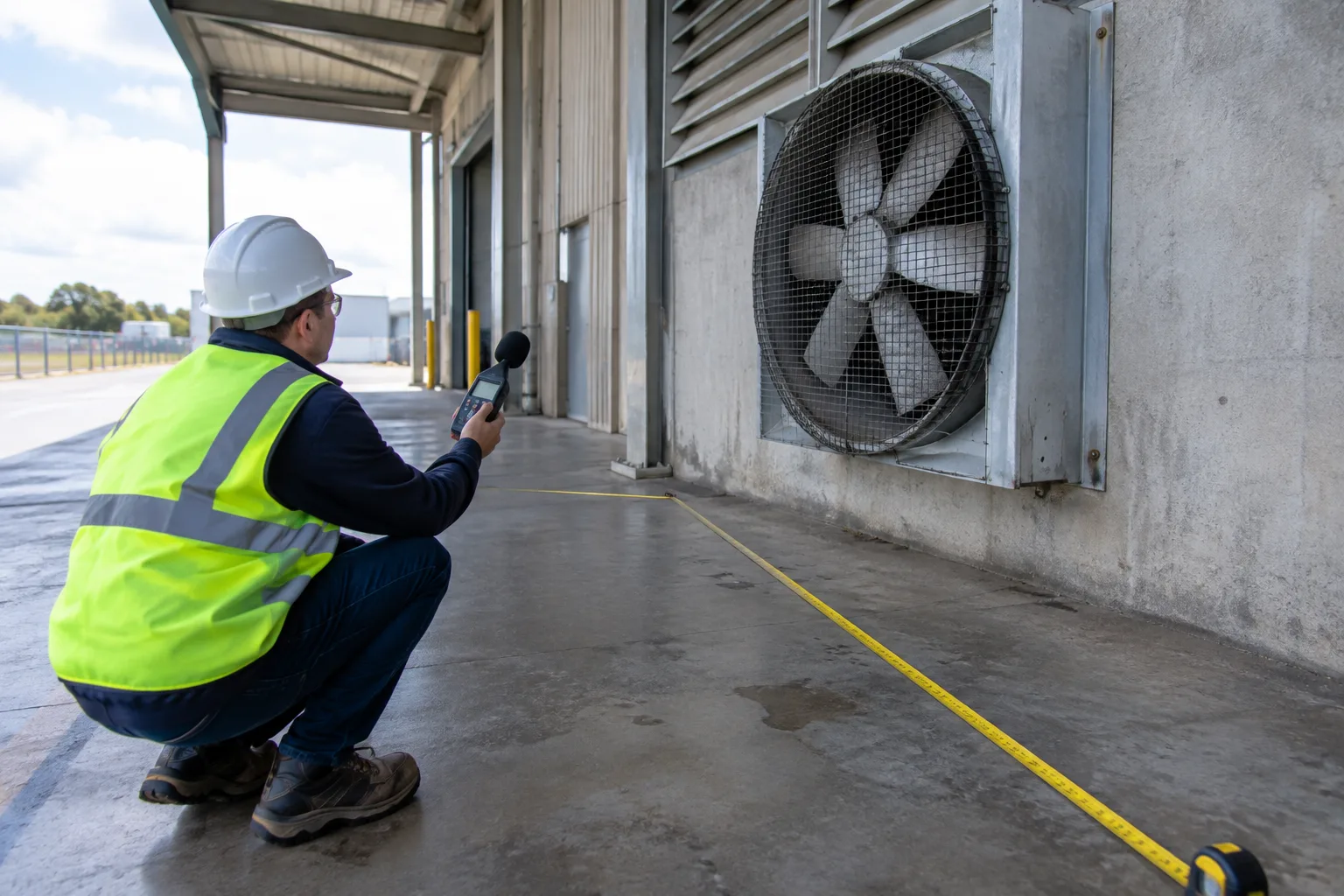
The decibel is a logarithmic scale, so the numbers do not add up the way buyers often expect. Doubling the sound energy adds about 3 dB, which means two identical fans running side by side measure roughly 3 dB louder than one, not twice the figure. As a widely used rule of thumb in acoustics, an increase of about 10 dB is heard as roughly twice as loud.
The "A" in dB(A) refers to A-weighting, a frequency filter defined for sound level meters in IEC 61672. It reduces the contribution of very low and very high frequencies to reflect how the human ear responds, which is why dB(A) is the unit used for workplace and environmental noise.
Sound pressure versus sound power
Two different quantities appear on fan data sheets, and mixing them up is the most common comparison error:
- Sound pressure level (Lp) is what a meter reads at a given point. It depends on distance from the fan and on the room: hard concrete walls and steel roofs reflect sound and raise the reading.
- Sound power level (Lw) is the total acoustic energy the fan emits. It is a property of the fan itself and does not change with the room, which makes it the fairer basis for comparing two fans.
Recognised test methods exist for both. ISO 13347 covers determination of industrial fan sound power under standardised laboratory conditions, AMCA Standard 300 describes the reverberant room method for sound testing of fans, and ISO 3744 sets out an engineering method for sound power using measurements around the source. A credible supplier should be able to tell you which method sits behind its figures.
Why distance matters
In open, free-field conditions, sound pressure falls by about 6 dB each time the distance from a point source doubles. Inside a factory, reflections mean the drop is smaller. So a figure quoted at 1 metre and another quoted at 3 metres cannot be compared directly. When you review any industrial fan noise level on a data sheet, check:
- Whether it is sound pressure or sound power
- The measuring distance and direction (inlet, outlet or side)
- The operating point (speed, air delivery and static pressure) at the time of the test
- The test standard or method used
Noise Limits That Apply in India
Fan noise matters for two groups: the people working near the fan and the neighbours beyond your boundary. For the second group, the Noise Pollution (Regulation and Control) Rules, 2000 set ambient limits of 75 dB(A) by day and 70 dB(A) by night for areas classified as industrial, with stricter limits for commercial, residential and silence zones. This is especially relevant for exhaust fans mounted on outer walls or roofs facing a residential area.
Workplace exposure for employees is governed separately under the factory rules framed by each state, so confirm the applicable limit with your safety officer or local factory inspectorate. Noise control also belongs alongside guarding and electrical safety in your plant's fan safety plan; see our article on safety measures for industrial fans.
How to Specify a Quieter Fan
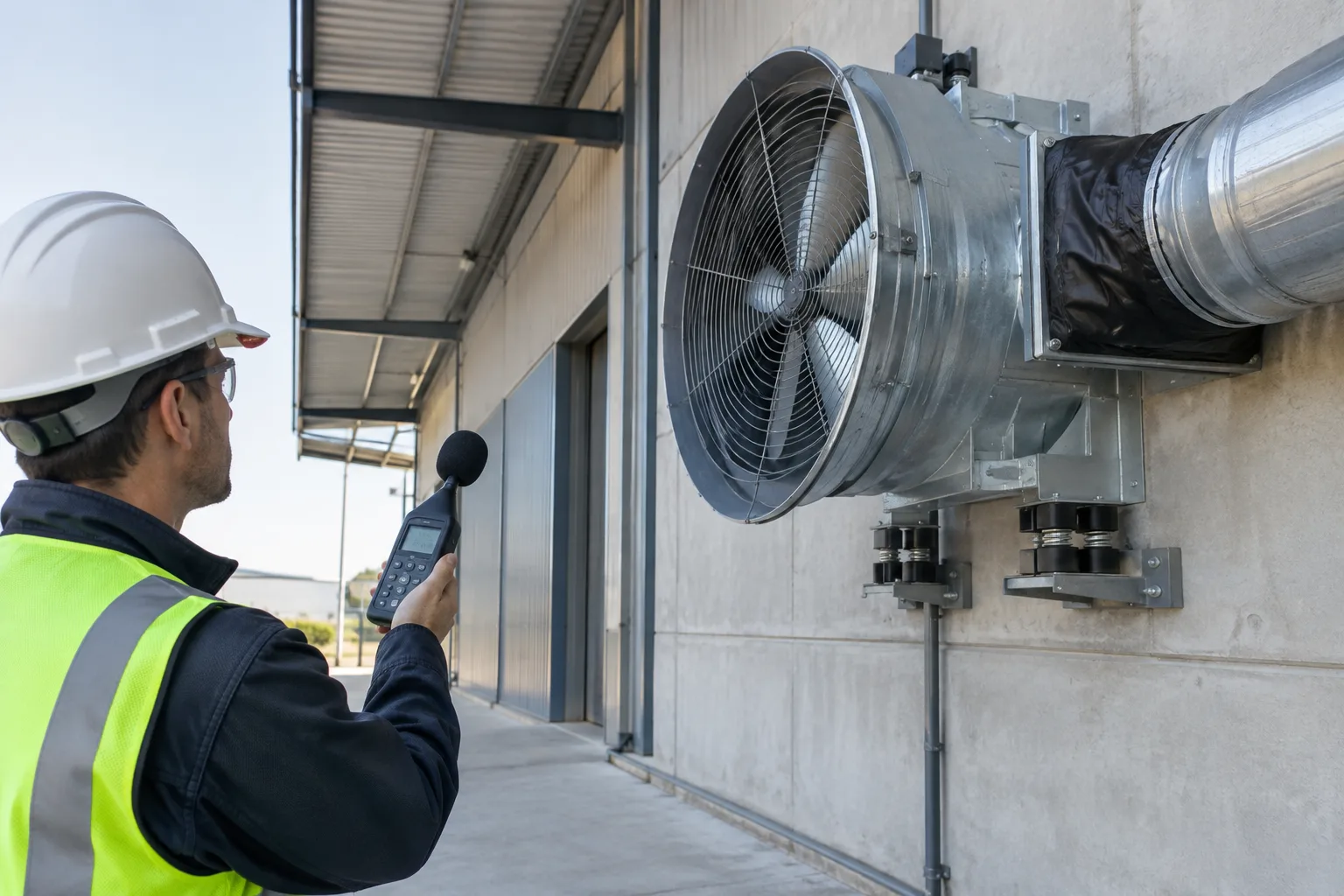
Most decisions about how to reduce industrial fan noise are made at the enquiry stage, before the fan is built. The following points give the manufacturer what it needs to select or design low noise industrial fans for your site:
- State the real duty point. Give the required air delivery and the system static pressure, not just a fan size. A fan selected close to its peak efficiency runs smoother and quieter than one forced off its curve.
- Choose larger and slower over smaller and faster. The fan laws used across the industry approximate the change in sound power as 50 times the logarithm of the speed ratio. On that basis, cutting speed by 20% lowers sound power by roughly 5 dB. A larger impeller at lower rpm can deliver the same air with a noticeably lower noise level.
- Ask about blade and impeller design. Aerodynamically designed blades and an aerofoil impeller reduce flow separation, giving higher air delivery and a minimum noise level for the same duty.
- Consider speed control. Where the airflow requirement varies through the day, running the fan slower during lighter demand reduces both noise and power use.
- Plan the installation. Allow straight duct runs at the inlet and outlet, use anti-vibration mounts and flexible connections, and keep guards and mounting hardware tight.
- Request sound data with conditions. Ask for the figure, the distance, the operating point and the test method together.
For wall and roof extraction, where boundary noise limits often apply, our range of heavy duty exhaust fans can be selected for the airflow you need at a speed that suits the location.
Low Noise Industrial Fans from an Industrial Fan Manufacturer in India
Alfa Fans was founded in 1981 in Mumbai and is a Manufacturer, Wholesaler and Exporter of heavy duty industrial fans, including air circulators, man coolers, heavy duty exhaust fans, tube axial fans and centrifugal blowers. The company is driven by engineers, and its in-house Research and Development team works with accredited test facilities to develop blade profiles and impellers for higher air delivery with lower noise.
Where a standard model does not fit your noise or airflow requirement, we manufacture custom made fans based on individual customer needs, including closed mesh fans for areas where guarding is a priority. Buyers comparing industrial fan manufacturers in India can review the full product range on our industrial fan manufacturers in India page.
To get a fan selected for your noise target, send us your required air delivery, static pressure, installation layout and any site noise limit through our contact page, and our engineers will recommend a suitable model with timely delivery.
Frequently asked questions
What is a normal industrial fan noise level?
There is no single normal figure, because noise depends on fan type, size, speed, operating point and the distance at which it is measured. A small fan running slowly can be far quieter than a large high-pressure blower. Always compare fans using sound data quoted at the same distance and operating point, or better, using sound power levels.
Why is my industrial fan louder on site than its data sheet says?
Data sheet figures are usually measured under controlled test conditions. On site, inlet bends, undersized ducts, higher static pressure than planned and reflective walls and roofs can all raise the reading. Mechanical issues such as worn bearings, imbalance or loose guards also add noise over time.
Does running a fan slower really reduce noise?
Yes. Under the fan laws used across the industry, sound power changes by about 50 times the logarithm of the speed ratio, so a 20% speed reduction lowers sound power by roughly 5 dB. Air delivery also falls, so the fan must be sized so the slower speed still meets your airflow requirement.
Can Alfa Fans build a fan to meet a specific noise requirement?
Alfa Fans manufactures custom made fans based on individual customer needs, supported by an in-house Research and Development team. Share your air delivery, static pressure, installation layout and noise target, and the engineering team will recommend or design a suitable fan.
What is the difference between dB and dB(A)?
dB is the raw decibel level across all frequencies. dB(A) applies A-weighting, a filter defined for sound level meters in IEC 61672, which reduces the influence of very low and very high frequencies to match human hearing. Workplace and environmental noise limits in India are expressed in dB(A).