
- Gala No. 19, 2nd Floor,
Bail Bazar, Mumbai, India - +91 88 5002 0455
info@alfafans.in

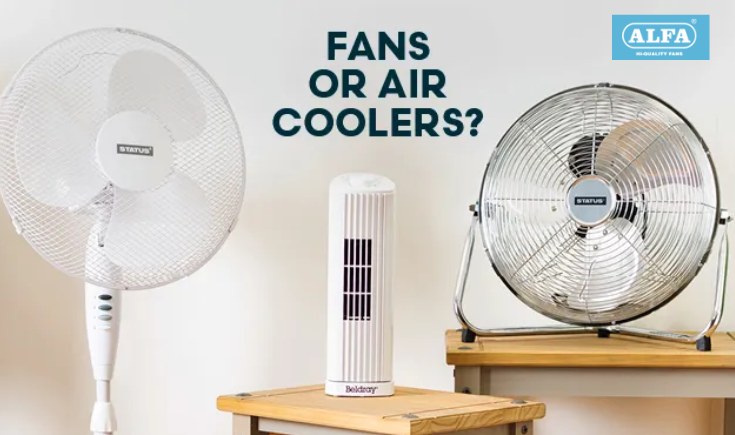
In today’s world, staying cool during the warmer months is a necessity. Whether it’s the blistering heat of summer or the sweltering temperatures in certain regions, we often turn to cooling devices to create a comfortable environment. Among the most common choices are
Before we dive deep into the debate of whether coolers are better than fans, let’s take a moment to understand how each of these devices works.
Fans are typically used to circulate air around a room. They don’t actually lower the temperature but create a breeze that can make us feel cooler due to the wind chill effect. The air moving across our skin helps to evaporate sweat, leading to a reduction in body temperature. However, if the room temperature is high, fans simply move around warm air and may not provide the same relief as cooler environments.
On the other hand, coolers, also known as evaporative coolers or swamp coolers, work by using water to cool down the air. These devices draw in hot air, pass it over water-soaked pads, and blow out the cool, moist air into the room. By utilizing the natural process of water evaporation, coolers can significantly lower the air temperature, especially in dry climates. The effectiveness of a cooler depends largely on the level of humidity in the air, as it works best in dry conditions.
Fans are popular because they are relatively inexpensive and energy-efficient. They are perfect for situations where the temperature is moderately high, and you want to improve air circulation in a room. Fans help to provide comfort by creating a cooling sensation, but they don’t lower the room temperature itself. If the room is already hot and humid, fans will circulate warm air, which might not provide much relief. They are most effective in spaces where the temperature isn’t too high, or where air movement is needed to prevent stuffiness.
However, fans have limitations when the humidity is high. In humid environments, the body’s natural cooling mechanism of sweating becomes less effective, which makes fans less useful for cooling down. Fans are designed to circulate air, not change its temperature, meaning they won’t help cool down a room as effectively as coolers do.
Coolers, in contrast, are designed to actively lower the air temperature. They use the principle of evaporation to cool the air, which makes them much more effective in dry climates. By drawing in hot air, evaporative coolers pass it through water-saturated cooling pads, and as the air evaporates the water, it cools down. This is an energy-efficient and eco-friendly way to bring down the temperature.
One of the primary advantages of coolers is that they reduce the temperature of the air in a room, making it more comfortable to be in. In a dry environment, a cooler can reduce temperatures by as much as 15-20 degrees Fahrenheit, offering substantial relief from the heat. However, if you live in a region with high humidity, coolers may not be as effective since the evaporation process relies on dry air.
Fans are relatively affordable when compared to coolers. Most fans are budget-friendly and come in various sizes and types, such as tower fans, box fans, and oscillating fans. Their energy consumption is also low, making them an economical choice for long periods of use. If you're looking for an inexpensive way to create a breeze and improve comfort, fans like Alfa Fans provide great value for money. They're available in a variety of designs and can be a great addition to any home or office space without breaking the bank.
While coolers are generally more expensive upfront than fans, they offer long-term benefits in terms of cooling efficiency. When comparing initial costs, a cooler can be several times more expensive than a basic fan. However, they use less electricity than air conditioners, making them more affordable to operate in the long run. The ongoing cost of running a cooler will depend on its size and the area you need to cool, but it is generally more affordable than using air conditioning units.
If you live in an area where summers are consistently hot and dry, investing in an evaporative cooler might make more sense than constantly using fans, which may not provide the cooling power you need during the peak of summer heat.
Fans are lightweight and easy to move from one room to another. Many fans are compact and can be placed anywhere you need them. They also don’t require installation or complex setup processes, making them convenient for renters or those who prefer flexibility. For instance, Alfa Fans are designed for maximum portability, allowing you to move them around the house with ease. If you're in a situation where you want cooling on-the-go, a fan is your best option.
While coolers can also be portable, they are generally bulkier than fans and may require more space. Larger coolers can be cumbersome to move around, especially if you need to transport them frequently. The setup process for a cooler is also more involved—water needs to be added regularly, and the cooler needs to be placed near an open window or vent to draw in fresh air. However, some compact models are designed for easier mobility, so it’s possible to find coolers that offer both efficiency and portability.
Fans are ideal for areas where the air is already warm but not overly humid. If you live in a region where temperatures are high but humidity is low, fans can be quite effective at making you feel cooler. However, in humid climates, fans may not be able to provide significant cooling because the high humidity prevents your body from sweating effectively. Fans, in this case, would simply circulate warm air around the room without much impact on cooling.
For those in hot and dry climates, evaporative coolers are the better option. They work best when humidity levels are low, as the evaporation process can effectively cool the air. Coolers like Alfa Fans combine the cooling power of a fan with the moisture needed for evaporation, making them a top choice for homes in arid regions. They are great for areas where the heat is dry and oppressive, as they can bring down temperatures significantly.
In areas with high humidity, however, coolers become less effective. The presence of too much moisture in the air prevents the evaporative process from taking place efficiently, and this can make coolers less useful in such regions.
Fans can offer comfort in terms of air circulation. They prevent stuffiness by promoting air movement, which is especially helpful in poorly ventilated rooms. Some people find fans helpful for sleep because the white noise can mask other disruptive sounds. However, there are some health concerns related to fans. Direct airflow can cause dry skin, dry eyes, or sinus issues if the fan is pointed directly at you for prolonged periods. Additionally, while fans provide cooling by evaporating sweat, they don’t address underlying heat, which can lead to discomfort in extreme temperatures.
Coolers provide a more consistent and effective method of cooling, and they also improve air quality by adding moisture to the air. This is particularly beneficial in dry climates where the air can become extremely arid and lead to dry skin, respiratory issues, and other health problems. The added humidity from a cooler can reduce these problems and make breathing easier.
Moreover, coolers tend to operate more quietly than fans, making them ideal for sleeping or for use in environments where noise is a concern.
Ultimately, if you want a cooling device that actively lowers the temperature in dry conditions, a cooler is the best choice. If you’re looking for a portable, low-cost