

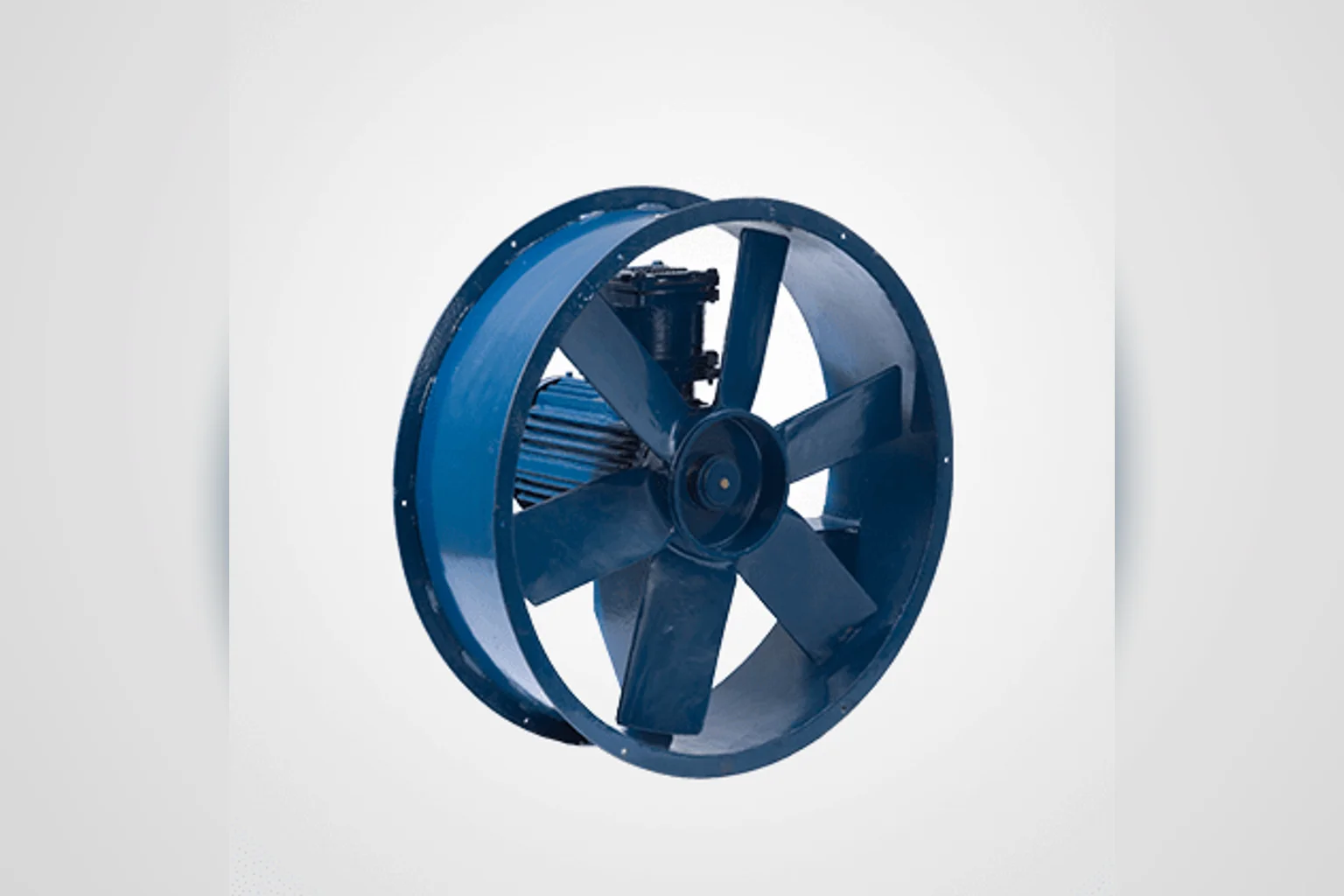
Flameproof Exhaust Fan Gas Group and Temperature Class: A Buyer's Specification Guide
- 9 November 2026
- Alfa Fans
- Industrial Exhaust Fans
To specify a flameproof exhaust fan correctly, you need three facts from your site's hazardous area classification: the zone, the gas group and the temperature class. The fan motor's Ex marking (for example, Ex d IIB T4) must cover all three. Its gas group must be equal to or stricter than the gas present, and its temperature class must keep every surface below the auto-ignition temperature of that gas.
Getting the flameproof exhaust fan gas group and temperature class right is what separates a compliant installation from one that fails a safety audit or, worse, becomes an ignition source. This guide explains each element in plain terms so purchase teams, plant managers and EPC contractors can send a complete enquiry the first time.
Why the Flameproof Exhaust Fan Gas Group and Temperature Class Matter
An exhaust fan in a solvent store, paint booth, chemical plant or pharmaceutical reactor room is often removing the very vapour that creates the hazard. That makes the motor, terminal box and impeller the most exposed electrical and mechanical components in the room. A flameproof (Ex d) motor is built so that if gas enters the enclosure and ignites, the enclosure contains the explosion and the flame paths cool any escaping gases so they cannot ignite the surrounding atmosphere.
That protection only works when the enclosure is designed for the specific gas and the surface temperature limits of that environment. A motor rated for a less demanding gas group, or with a temperature class that allows surfaces to run too hot, is not suitable, even if it looks identical. If you want the regulatory background on where these fans are compulsory, our guide on where and why flameproof exhaust fans are mandatory covers that in detail.
Hazardous Zones: Where the Fan Will Operate
Hazardous areas are classified by how often an explosive atmosphere is likely to be present. The IEC 60079 series, adopted in India as IS/IEC 60079, defines the zones for gases and vapours, with area classification covered under IEC 60079-10-1:
- Zone 0: an explosive gas atmosphere is present continuously or for long periods, such as inside a solvent tank.
- Zone 1: an explosive atmosphere is likely to occur during normal operation, such as around filling points or open process vessels.
- Zone 2: an explosive atmosphere is not likely in normal operation and, if it occurs, lasts only a short time, such as areas around flanges and valves.
Flameproof Ex d motors are generally used in Zone 1 and Zone 2. They are not intended for Zone 0. Combustible dust areas follow a separate classification (Zones 20, 21 and 22, with dust groups IIIA, IIIB and IIIC), and they need dust-rated equipment rather than a gas-rated flameproof motor alone. Your site's area classification drawing, usually prepared by the process or safety consultant, is the document that tells you which zone applies.
Gas Groups IIA, IIB and IIC Explained
Group II covers surface industries with explosive gases (Group I is reserved for mining). Within Group II, gases are divided by how easily an ignited flame can travel through a narrow gap, which determines how tight the flameproof enclosure's flame paths must be:
- IIA: the least demanding group. Propane is the typical reference gas, and many common hydrocarbon solvents and fuels fall here.
- IIB: more demanding. Ethylene is the typical reference gas.
- IIC: the most demanding group, covering hydrogen and acetylene.
The rule for buyers is simple: a higher group covers the lower ones. An IIC motor is suitable for IIB and IIA gases, and a IIB motor is suitable for IIA gases, but never the reverse. Specifying IIC when your gas is IIA usually adds cost and can limit motor availability, so specify what your area classification actually requires, not the maximum by default.
Temperature Classes T1 to T6
Every flammable gas has an auto-ignition temperature, the point at which it will ignite on a hot surface without any spark. The temperature class on the motor tells you the maximum surface temperature the equipment can reach. IEC 60079-0 sets these limits:
- T1: 450°C
- T2: 300°C
- T3: 200°C
- T4: 135°C
- T5: 100°C
- T6: 85°C
The equipment's maximum surface temperature must be lower than the auto-ignition temperature of the gas present. A T4 motor is therefore also suitable wherever T3, T2 or T1 is required. Gas group and temperature class are independent: hydrogen is IIC but has a high ignition temperature, while some IIA or IIB solvents ignite at much lower temperatures. You need both values, which is why we ask for them separately.
How to Read a Flameproof Marking
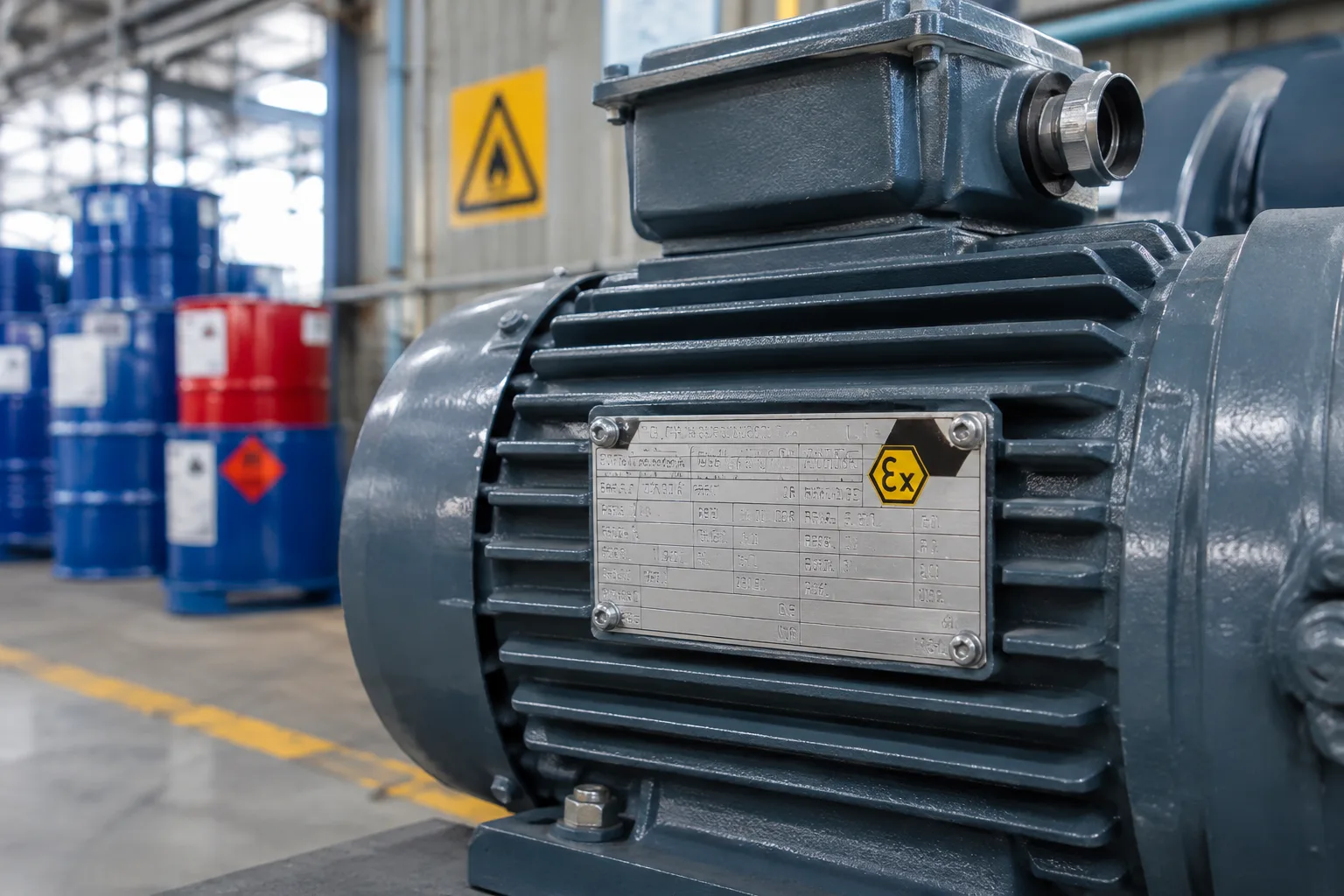
A typical nameplate on an industrial flameproof exhaust fan motor reads something like Ex db IIB T4 Gb. Here is what each part means:
- Ex: equipment designed for explosive atmospheres.
- d or db: flameproof enclosure protection.
- IIB: the gas group it is designed for.
- T4: maximum surface temperature of 135°C.
- Gb: equipment protection level suitable for Zone 1 (Gc corresponds to Zone 2).
In India, flameproof equipment for hazardous areas is typically expected to carry testing certification to IS/IEC 60079 and approval from PESO (Petroleum and Explosives Safety Organisation). Always confirm the exact approvals your site, insurer or client requires, and ask your supplier for the motor's certificate copy along with the quotation.
Flameproof, Explosion Proof and Spark Resistant: Not the Same Thing
These terms are often used interchangeably in enquiries, but they describe different things:
- Flameproof (Ex d): the IEC term for an enclosure that contains an internal explosion. This is the standard terminology in India, the UAE and most IEC markets.
- Explosion proof exhaust fan: the North American term for broadly similar protection under a different certification system. If your drawings say "explosion proof", confirm whether the client needs IEC-based Ex d or a North American listing.
- Spark resistant industrial fan: refers to the fan's mechanical construction, such as non-sparking impeller or rubbing-ring materials that reduce the risk of sparks if the impeller contacts the casing. AMCA International publishes spark-resistant construction classifications for this.
A complete hazardous area exhaust fan often needs both: a certified flameproof motor and a mechanically spark-resistant construction around the impeller and casing. The motor alone does not protect against a steel blade striking a steel ring.
What to Send Flameproof Exhaust Fan Manufacturers for a Quotation
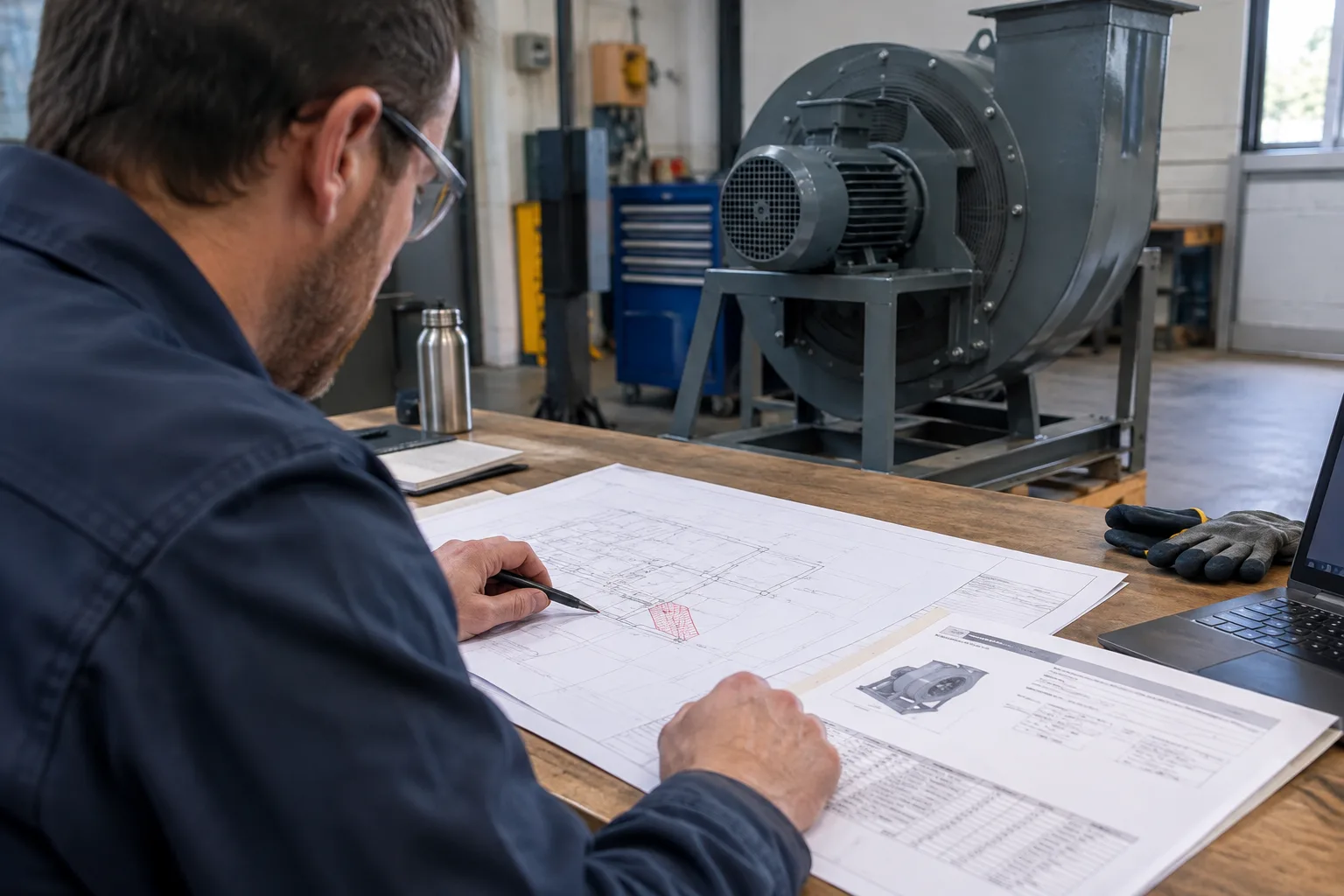
A clear enquiry saves days of back-and-forth. Before contacting flameproof exhaust fan manufacturers, gather:
- Hazardous zone (Zone 1 or Zone 2) and the area classification drawing if available
- Gas or vapour being handled, with gas group and temperature class
- Required air delivery (CFM or m³/hr) and static pressure, especially if the fan is ducted
- Mounting type: wall-mounted, duct-mounted or roof-mounted
- Fan diameter or opening size, if replacing an existing unit
- Ambient temperature, humidity and any corrosive vapours, which affect material selection
- Power supply (voltage, phase, frequency)
- Required certifications and quantity, with delivery location
For a wider look at exhaust configurations, including fans with protective covers, see our heavy duty exhaust fans range, or our overview of exhaust industrial fan manufacturing in India.
Working With Alfa Fans on Hazardous Area Exhaust
Alfa Fans has been manufacturing heavy duty industrial fans in Mumbai since 1981. As a Manufacturer, Wholesaler and Exporter, we supply flameproof exhaust fans alongside our wider range of exhaust fans, tube axial fans and centrifugal blowers. Our engineer-led Research and Development team builds custom made fans around operating conditions, so impeller design, air delivery and mounting can be matched to your duct layout and process.
We supply chemical, pharmaceutical and process plants across Maharashtra, including Thane and Panvel, as well as clients across India and export markets such as the UAE, Nepal and Bhutan. Oil, gas and petrochemical buyers may also find our article on industrial fans in oil and gas facilities useful when planning ventilation for larger sites.
Send us your zone, gas group, temperature class and airflow and static-pressure requirements, and our team will provide technical product guidance and a quotation. Discuss your application requirements with Alfa Fans to get a fan specified correctly with timely delivery.
Frequently asked questions
Can I use a IIC flameproof exhaust fan in a IIA area?
Yes. A higher gas group covers the lower ones, so a IIC motor is suitable for IIB and IIA gases. However, IIC equipment usually costs more and may have longer lead times, so specify the group your area classification actually requires.
Is a flameproof exhaust fan suitable for Zone 0?
No. Flameproof Ex d motors are generally intended for Zone 1 and Zone 2 areas. Zone 0, where an explosive atmosphere is present continuously, requires a different level of protection and is rarely a location for an exhaust fan motor.
What temperature class should I choose for my flameproof exhaust fan?
Choose a temperature class whose maximum surface temperature is below the auto-ignition temperature of the gas or vapour in your area. T3 and T4 are common in chemical and pharmaceutical plants, but your area classification or the gas's data sheet should confirm the requirement.
Is an explosion proof exhaust fan the same as a flameproof one?
They provide broadly similar protection but come from different certification systems. Flameproof (Ex d) is the IEC term used in India and the UAE, while explosion proof is the North American term. Confirm which certification your client or site requires before ordering.
Does Alfa Fans make custom flameproof exhaust fans?
Alfa Fans manufactures flameproof exhaust fans and builds custom made fans to individual customer requirements. Share your zone, gas group, temperature class, airflow and mounting details and our team will advise on a suitable configuration and quotation.