

Introduction
Designing an efficient industrial ventilation or air handling network involves much more than simply selecting a fan that moves a high volume of air. To ensure proper airflow through complex duct layouts, filtration units, and exhaust hoods, engineers must master the fundamental principles of aerodynamic pressure.
Within any mechanical air movement system, pressure behaves according to well-defined physical laws. Specifically, air pressure is divided into two primary components: static pressure and dynamic pressure. Understanding how these two forces interact—and how they impact heavy-duty centrifugal blowers and exhaust systems—is vital for optimizing facility safety, energy efficiency, and operational performance.
What is Static Pressure?
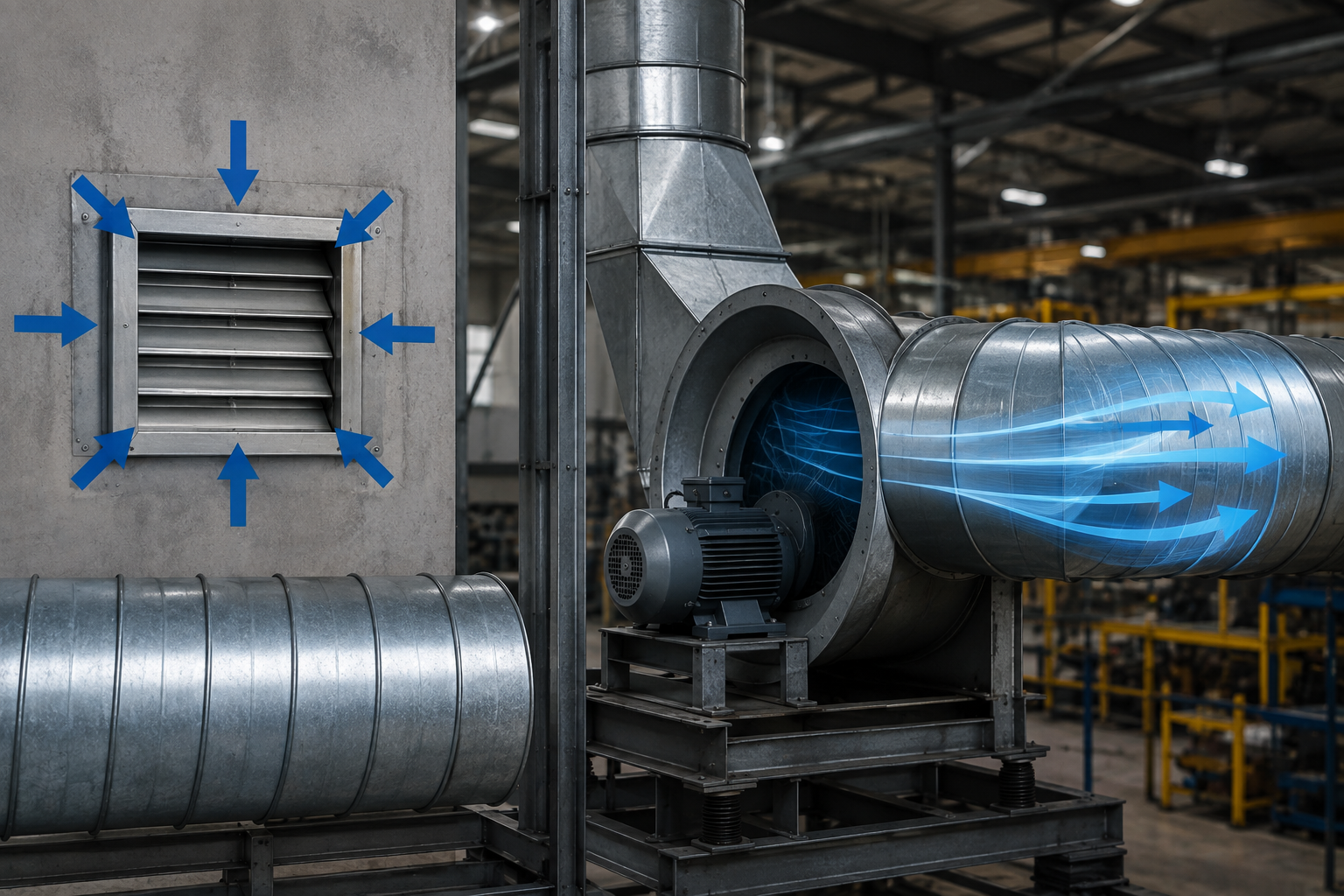
Static pressure (SP) is the potential energy exerted equally in all directions against the interior walls of a duct or containment structure. Think of it as the resistance force that the ventilation system must constantly fight against.
As air travels through an industrial network, it encounters various obstacles that impede smooth flow:
- Frictional drag along the interior surface of metal ductwork.
- Turbulence caused by elbows, bends, transitions, and dampers.
- Pressure drops across particulate air filters, scrubbers, and heat exchangers.
Static pressure can be positive (pushing air outward, typically on the discharge side of a fan) or negative (pulling air inward, typically on the suction intake side).
What is Dynamic Pressure?
Dynamic pressure (DP), also known as velocity pressure, represents the kinetic energy of the moving air stream. Unlike static pressure, which pushes outward on duct walls, dynamic pressure only exists when air is in motion and always acts in the direction of the airflow.
Dynamic pressure depends directly on two main factors: the density of the air and the speed (velocity) at which the air is traveling. In high-velocity industrial exhaust systems designed to capture heavy dust or fumes, dynamic pressure plays a critical role in maintaining transport velocity so particulates do not settle inside the ducts.
The Core Equation: Total Pressure
In any industrial ventilation system, the total energy supplied by a centrifugal blower or exhaust fan is expressed as Total Pressure (TP). The relationship between these pressure types is governed by a fundamental formula:
Total Pressure (TP) = Static Pressure (SP) + Dynamic Pressure (DP)
While static pressure overcomes system resistance to keep air moving, dynamic pressure provides the kinetic energy required to accelerate air and discharge it out of the system.
Comparison: Static Pressure vs. Dynamic Pressure
| Feature | Static Pressure (SP) | Dynamic Pressure (DP) |
|---|---|---|
| Definition | Potential energy exerted uniformly against duct walls. | Kinetic energy associated with directional air movement. |
| Direction | Acts equally in all directions (perpendicular to walls). | Acts exclusively in the direction of airflow. |
| Primary Function | Overcomes friction, system resistance, and filter drops. | Drives air velocity and kinetic momentum. |
| Dependence | Duct layout, fittings, components, and restrictions. | Air density and flow velocity squared. |
Why Pressure Dynamics Matter for Fan Selection
Miscalculating static or dynamic pressure during the design phase can lead to severe operational issues. If a fan is undersized and cannot overcome the system's static pressure resistance, the actual airflow rate will fall far below required ventilation standards, leading to hazardous accumulation of heat, fumes, or dust. Conversely, oversizing a fan wastes electrical energy and creates excessive noise and mechanical wear.
When engineering ventilation networks for severe industrial environments, selecting the correct fan type—such as robust centrifugal blowers or high-performance tube axial fans—requires precise system pressure profiling.
Conclusion
Balancing static and dynamic pressure is an essential discipline in industrial ventilation engineering. By accurately calculating system resistance and velocity requirements, facilities can eliminate airflow bottlenecks and maximize energy efficiency.
Reliable air movement starts with expertly engineered equipment. Alfa Fans designs and manufactures a comprehensive range of heavy-duty industrial fans, centrifugal blowers, and exhaust systems tailored to handle demanding static pressure requirements across diverse manufacturing sectors. Contact our technical team today to find the ideal ventilation solution for your facility.