

Factory Exhaust Fan Make Up Air: Why Exhaust Fans Underperform and How to Size Inlets
- 10 November 2026
- Alfa Fans
- Industrial Exhaust Fans
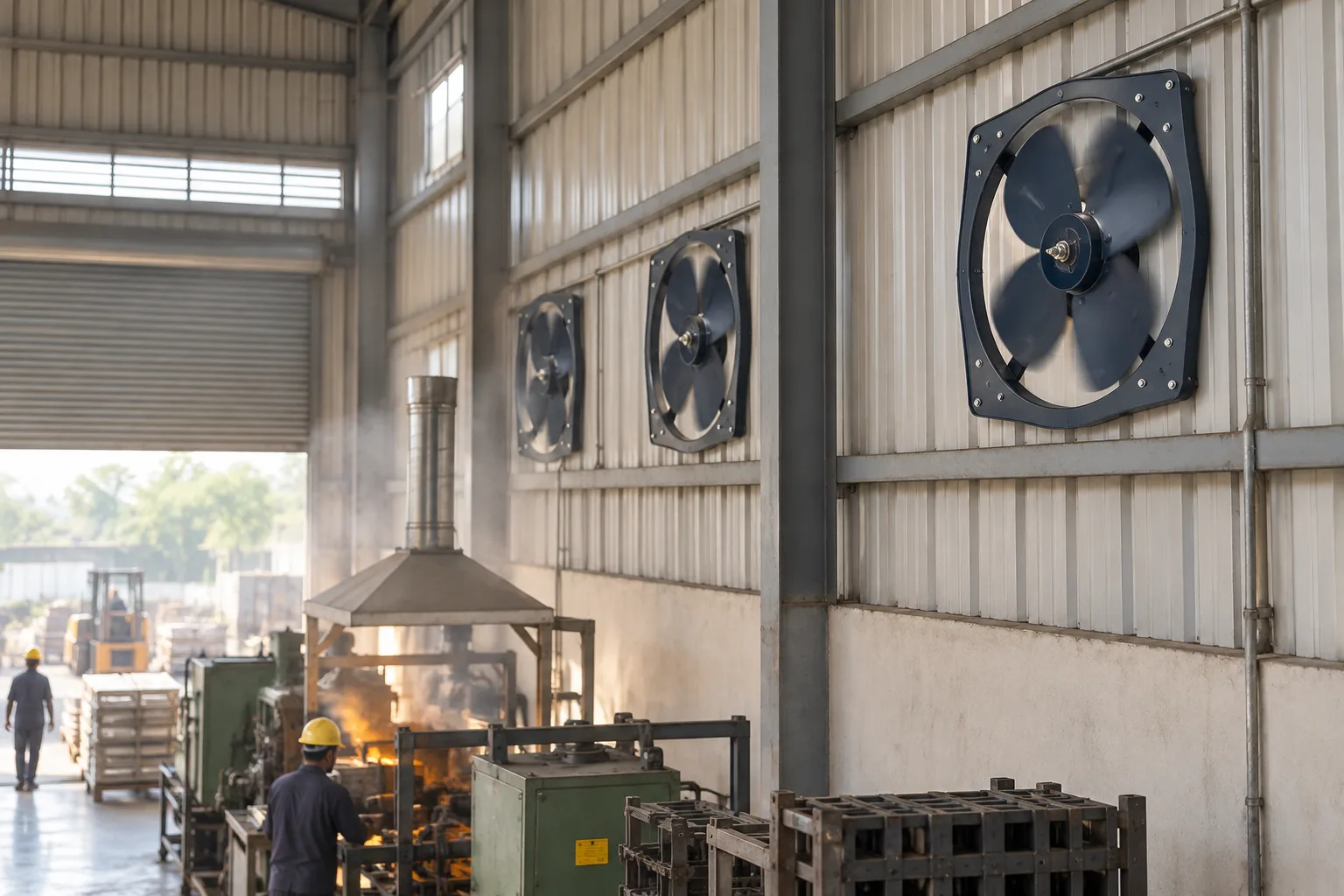
A factory exhaust fan can only push out as much air as the building lets back in. Without enough make up air coming through fresh air inlets, the shed goes into negative pressure. The static pressure the fan works against rises, and its air delivery falls well below the catalogue figure. The fix is to provide inlets with enough net free area for your total exhaust volume, placed low and on the opposite side of the work zone, so fresh air sweeps through the area you actually want ventilated.
Why factory exhaust fan make up air decides how much air you really move
Air that leaves a building must be replaced by an equal amount of air coming in. This is simple conservation of mass, and no fan design can get around it. If a plant has four exhaust fans on the roof or the gable wall and the shutters, windows and doors are mostly closed, the replacement air has to squeeze in through cracks, gaps under doors and whatever openings happen to exist. Each of those small openings adds resistance.
That resistance shows up at the fan as extra static pressure. The fan is now trying to pull air out of a room that is slightly under vacuum. Its impeller keeps turning at the same speed and the motor keeps drawing power, but less air passes through it. Plant managers then conclude the fan is undersized or faulty, add another fan, and make the problem worse, because the new fan competes for the same limited inflow.
The ACGIH publication Industrial Ventilation: A Manual of Recommended Practice for Design, a standard reference for ventilation engineers, treats replacement (make-up) air as an integral part of any exhaust system rather than an optional extra. Planning factory exhaust fan make up air at the design stage costs far less than correcting a starved system after commissioning.
Signs your industrial exhaust fans are starved of air
You can usually spot a make-up air problem on the shop floor without instruments. Common symptoms include:
- Doors that are hard to open, slam shut, or whistle when slightly ajar.
- Fumes, smoke or heat lingering near process areas even though the exhaust fans are running.
- Fumes from furnaces, ovens or DG sets being pulled back indoors through flues or nearby openings (backdraft).
- Dust and insects drawn in through every gap, especially around loading bays.
- Exhaust fans that sound strained, with a noticeable change in pitch when a large shutter is opened.
- Opening a single door or shutter clearly improves airflow across the shed.
That last check is the quickest test. If opening a shutter makes the fans visibly more effective, the fans were never the limitation. The inlets were.
How static pressure changes exhaust fan performance
Every fan has a performance curve that plots air delivery against static pressure. Ratings are typically established under laboratory conditions using methods such as ANSI/AMCA 210, the Air Movement and Control Association standard for testing fan aerodynamic performance. As static pressure rises along that curve, air delivery drops. Propeller-type wall and roof exhaust fans are designed for high-volume airflow at low static pressure, so their delivery falls away quickly once the building starts resisting.
This is why the free-air figure on a brochure only holds when the building can breathe freely. When you request a quotation for heavy duty exhaust fans, give the supplier your expected operating static pressure, or at least describe the inlet arrangement, so the fan is selected at its real duty point rather than at zero pressure. Where ducts, filters or long runs are involved, a tube axial or vane axial design may handle the higher pressure better; our article on the difference between tube axial and vane axial fans explains where each fits.
How to size make-up air inlets
Inlet sizing follows a straightforward sequence. Your ventilation consultant or fan supplier can confirm the figures, but the logic is the same for any factory.
- Total the exhaust volume. Add up the rated air delivery of all exhaust fans that will run at the same time, in m³/h or CFM, at their expected operating pressure.
- Choose a design inlet velocity. Lower velocity through the inlet means lower resistance, less noise and less draught on workers near the opening. Your designer sets this value based on the application.
- Calculate the net free area. Divide the airflow by the inlet velocity. As an illustration only: 36,000 m³/h is 10 m³/s; at a chosen velocity of 2 m/s you would need 5 m² of net free area.
- Convert net free area to gross opening size. Louvres, bird mesh, insect screens and rain hoods all block part of the opening. Use the louvre maker's published free-area data, not the overall frame size.
- Decide the pressure balance. Most production areas run slightly negative so odours and fumes do not spread to offices. Food-processing and pharmaceutical areas often need the opposite, with filtered supply air keeping clean zones under positive pressure.
Undersized inlets are the most common mistake. Gross wall openings look generous on a drawing, but once louvres and mesh are fitted, the usable area can be considerably smaller.
Where to place fresh air inlets in a factory
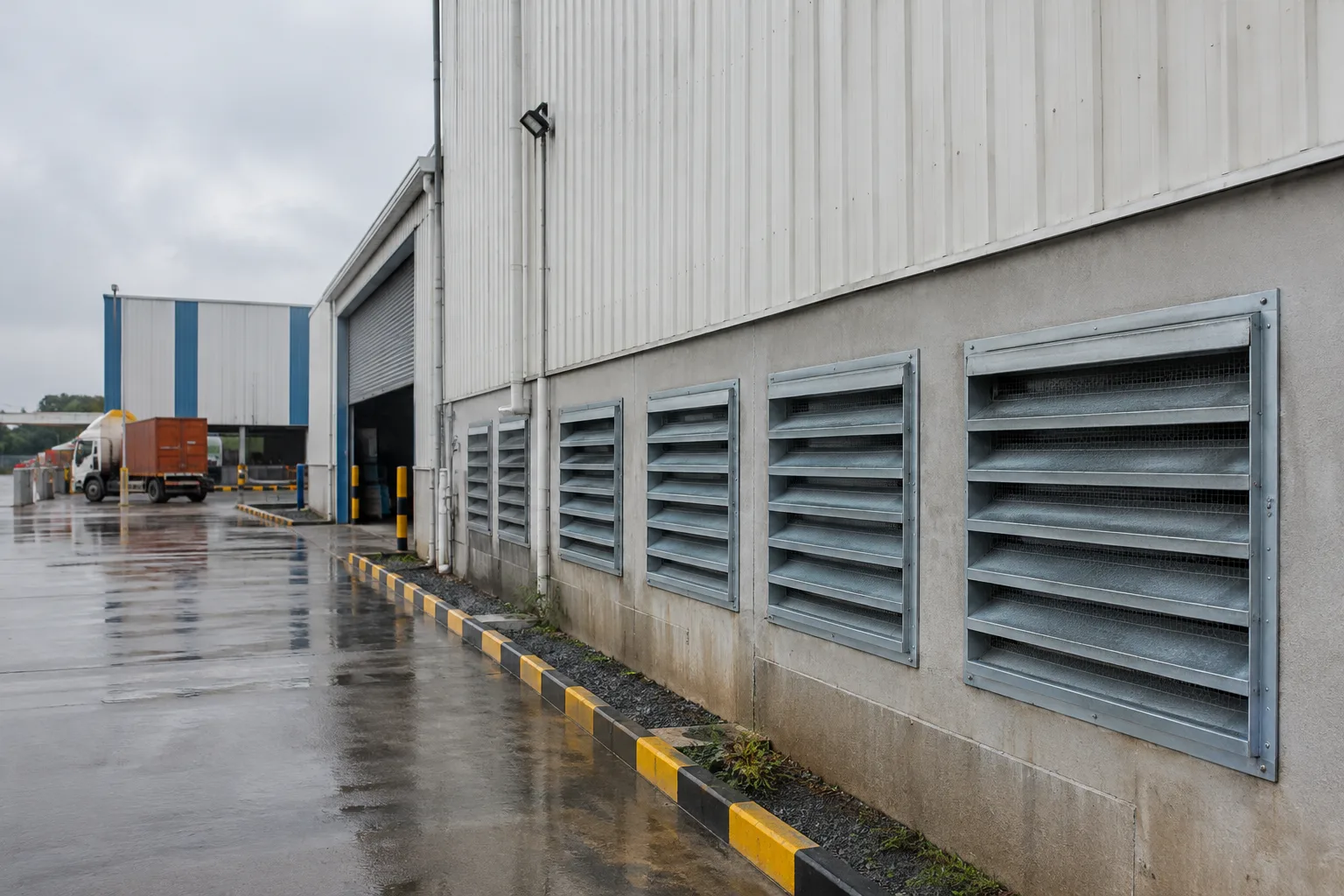
Correct sizing is wasted if the inlets sit in the wrong place. Air takes the shortest path from inlet to exhaust fan, so placement decides which part of the shed actually gets ventilated.
- Opposite the exhaust fans. Place inlets on the far wall so fresh air crosses the full width of the work zone before leaving.
- Low inlets, high exhaust. Hot air rises. In forging, moulding, glass and foundry sheds, low-level inlets with exhaust fans near the roof line work with natural buoyancy instead of against it.
- Away from contaminant sources. Keep inlets clear of DG set exhausts, loading docks where trucks idle, effluent areas, and the discharge of your own or a neighbouring unit's exhaust fans, to avoid re-circulating dirty air.
- Not right beside an exhaust fan. An inlet next to a fan short-circuits the airflow and leaves the rest of the floor stagnant.
- Protected from weather. In Mumbai, Thane and Panvel, monsoon rain driven by wind will enter any open louvre. Use rain-resistant louvres or hoods, and specify an exhaust fan with cover on the outlet side so the system can stay in service through the season.
Passive inlets or powered supply fans?
Passive louvres work well for general factory ventilation where the exhaust volume is moderate and outside air quality is acceptable. Powered supply fans make more sense when the exhaust volume is large, when incoming air must pass through filters (dusty surroundings, food or pharmaceutical production), or when you need to control pressure in specific rooms precisely. In many industrial estates, a combination works best: exhaust fans on one side, and a smaller number of supply fans or tube axial fans pushing filtered fresh air in from the other.
Selecting factory exhaust fans with the inlet design in mind
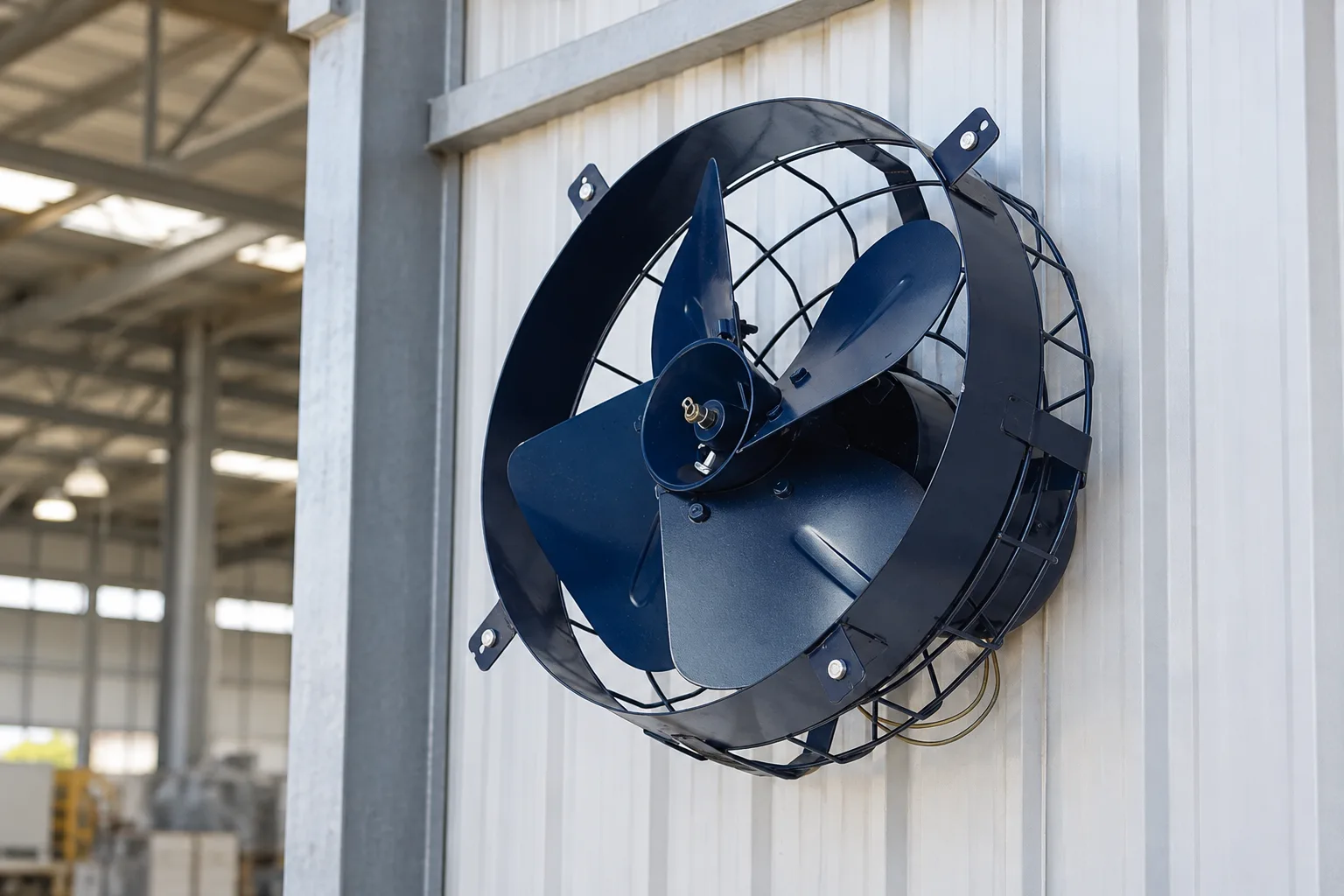
The best results come when the exhaust fans and the make-up air path are specified together. Before you finalise a purchase, share the following with your supplier:
- Shed length, width and eaves height, plus a rough layout.
- Heat sources, fume sources and the processes you are ventilating.
- Existing openings, shutters, louvres and their sizes.
- Whether the area handles flammable vapours or dust, which may call for flameproof exhaust fans.
- Site conditions such as coastal humidity, corrosive fumes or high dust load.
Alfa Fans has manufactured heavy duty industrial fans in Mumbai since 1981 and was featured by Kompass among its Top 10 Industrial Fan Manufacturers in India in 2024. As a Manufacturer, Wholesaler and Exporter, our engineer-led Research and Development team designs custom made fans around operating conditions, including heavy-duty exhaust fans, flameproof exhaust fans, tube axial fans and centrifugal blowers. If you are comparing heavy duty exhaust fan manufacturers, our introduction to heavy duty exhaust fans covers construction and application basics.
Whether your plant is in Andheri, Taloja near Panvel, Pune or further afield, we can review your layout and airflow and static-pressure requirements before recommending a fan. Discuss your application requirements with our team to request a quotation and technical product guidance.
Frequently asked questions
What is make-up air for a factory exhaust fan?
Make-up air is the fresh outdoor air that replaces the air your exhaust fans remove. Every cubic metre pushed out must be replaced by a cubic metre coming in. Without planned inlets, that air leaks in through gaps, the building goes under negative pressure and the fans move less air.
Why are my factory exhaust fans not removing heat and fumes properly?
The most common cause is insufficient fresh air inlets rather than a weak fan. A quick test is to open a large shutter while the fans run; if airflow improves noticeably, the fans are starved of make-up air. Undersized fans, wrong placement or worn components are the other causes to check.
How big should fresh air inlets be for my exhaust fans?
Divide your total exhaust airflow by the inlet velocity your designer chooses to get the net free area needed. Then allow for louvres, mesh and rain hoods, which reduce the usable opening, using the louvre maker's free-area data. Our team can help work this out from your fan schedule and shed layout.
Do I need supply fans or are wall louvres enough?
Passive louvres are usually enough for general factory ventilation with moderate exhaust volumes. Powered supply fans are better when exhaust volumes are large, when incoming air must be filtered, or when rooms need controlled positive or negative pressure, as in food and pharmaceutical plants.
Can Alfa Fans supply exhaust fans for projects outside Mumbai?
Yes. Alfa Fans is a Mumbai-based manufacturer supplying across India, including Pune, Bengaluru, Hyderabad, Chennai and Delhi NCR, and exports to markets such as the UAE, Nepal and Bhutan. Share your application details to request a quotation.